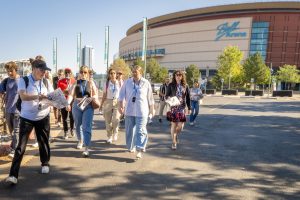
Colorado State University’s 2025 Urban Design Challenge brought students, professionals, and industry experts together for two intensive events aimed at reimagining high-profile urban spaces in Colorado.
The Fort Collins challenge (August 4-7) centered on redesigning the city’s Midtown mall corridor, while the Denver challenge (August 11-14) tackled one of the city’s most talked-about development projects: the future of the Ball Arena complex.
Denver: The future of Ball Arena
Hosted at CSU’s SPUR Campus, the Denver UDC paired teams of planners, engineers, designers, and resource experts with site visits, workshops, and collaborative design challenges. The goal: create sustainable and interconnected visions for the redevelopment of the Ball Arena site, currently under discussion for major changes to traffic, housing, and other land use.
Kroenke Sports & Entertainment, owner of the property, envisions a new neighborhood connected to the city and inspired by direct community engagement, according to their website. SAR+, contracted to design the redevelopment area, provided guided tours of the site and insight into the planning process.
“It was an amazing opportunity to influence the future of Denver infrastructure and critically incorporate all communities in future generations,” said Ashley Paz-Perlera, a Metropolitan State University of Denver civil engineering technology student who participated in the event.
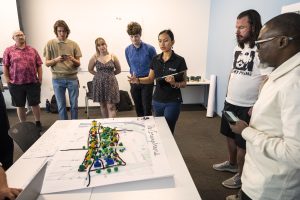
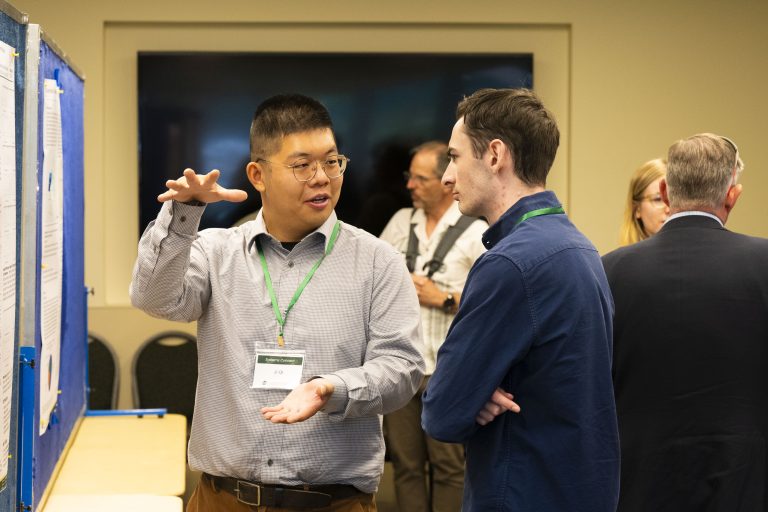
Over four days, participants:
- Discussed key challenges facing cities, from transportation and affordability to human behavior.
- Explored the Ball Arena site and learned about redevelopment plans from SAR+.
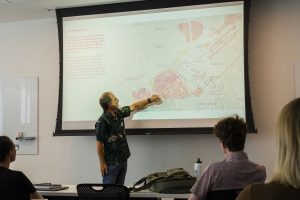
- Took deep dives into energy systems, systems thinking, and low-impact water strategies with experts.
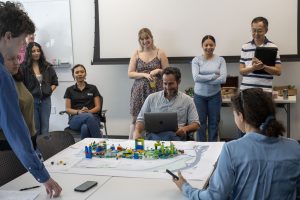
- Developed scenarios integrating water, energy, and community priorities, with ideas ranging from net-positive energy designs to trolleys, community gardens, and advanced stormwater systems.
- Wrapped up with a LEGO design-build challenge to bring their visions to life.
Key insights highlighted systems thinking in the intricate nature of city design, from managing traffic flow to creating livable spaces in high-density areas. Participants explored how to plan with future generations and emerging technologies in mind, while also navigating the realities of current zoning laws and other constraints.
“CSU’s land-grant mission calls us to engage in meaningful, grounded work that benefits our state,” said Steve Conrad, associate professor at the CSU Systems Engineering Department and the lead for the event. “We’re excited to collaborate with the people and organizations who have the vision and authority to shape the future of our cities.”
Fort Collins: Rethinking Midtown
The Fort Collins challenge featured an equally packed agenda, with site visits to the Foothills Mall and Poudre River systems, scenario planning for resilient futures, and an energetic LEGO challenge.
“I thought it would be good experience to learn something practical and applied,” said Jasmine Kensora, a third-year mechanical engineering and computer science dual major. “It’s been interesting. I can now see the area as an engineer would, like how water flows off buildings and through parking lots.”
Impact and thanks
Both events were led by experts from CSU’s Walter Scott, Jr. College of Engineering, industry partners, and beyond, with the support of Innosphere, chief sponsor for both challenges.
Special thanks to all faculty, guest speakers, judges, and support staff, including:
- Scott Carman – Colorado State University, Landscape Architecture
- Dixie Lin Poteet – CSU, Systems Engineering (Facilitator)
- Joshua Oluwatumise – CSU, Systems Engineering (Facilitator)
- Shanti Pless – National Renewable Energy Laboratory
- Tim Coburn – CSU, Systems Engineering
- Erika Gallegos – CSU, Systems Engineering
- Basil Hamdan – Civil engineer, City of Fort Collins
- Graeme Troxell – CSU, Systems Engineering
- Thomas Bradley – CSU, Systems Engineering
- Katie Bond – CSU, Systems Engineering (Judge)
- Aaron Brown – CSU, Systems Engineering (Judge)
- Ellison Carter – CSU, Civil and Environmental Engineering (Judge)
- Jocelyn Hittle – CSU Spur
- Jacob Weimann – CSU, Systems Engineering
- Jennifer Kovarik – University of Colorado Denver
- Maeve Nevins-Lavtar – City of Sandpoint, Idaho
- Madison Wilson – Shears Adkins Rockmore Architects (SAR+)
- Melyssa C. Hartzell – Martin/Martin Consulting Engineers
- Cassy Cadwallader – Auraria Higher Education Center
- Runing Zhang – Metropolitan State University of Denver (Judge)
- Judah Gaioni – CSU, Stormwater Center
- Austin Krcmarik – Denver Water
- Damian Higham – Denver Water
- Drew Halpern – City and County of Denver, Climate Action, Sustainability and Resiliency
- Joshua Sperling – National Renewable Energy Laboratory (Judge)
- Tanja Rauch-Williams – Metro Water Recovery (Judge)
- Brian Johnston – Innosphere (Sponsor)