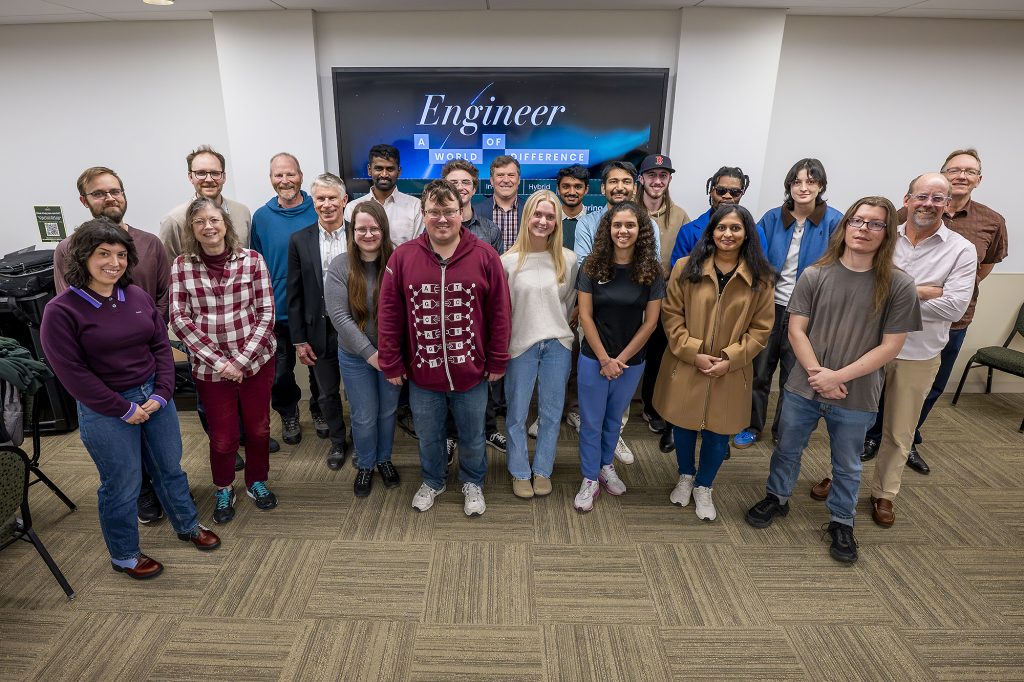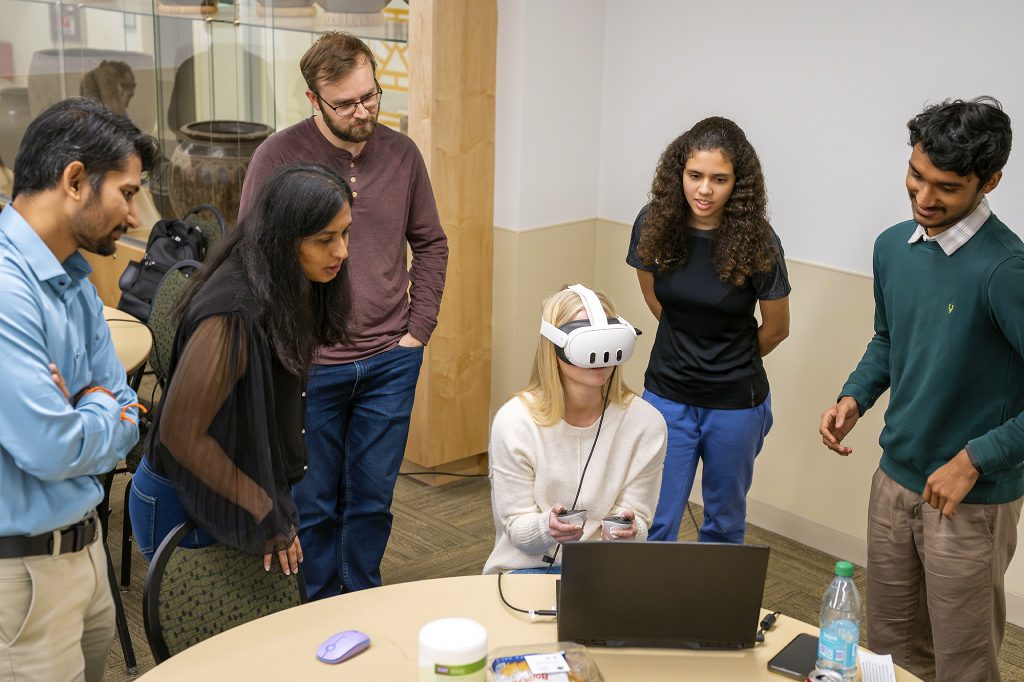
Colorado State University students re-envisioned climate education as teams presented virtual reality projects focused on climate resilience during a final showcase in the Lory Student Center, Nov. 21.
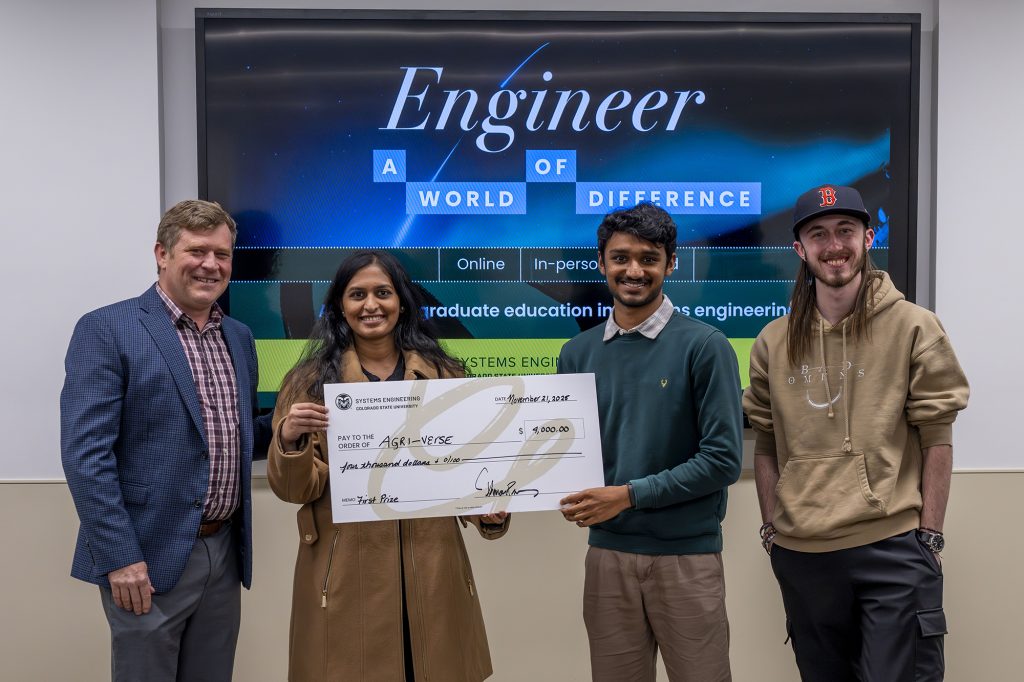
The event was the conclusion of an 8-week Virtual Reality Challenge organized by the Department of Systems Engineering. Systems Engineering served as the primary sponsor, with support from Innosphere Ventures and the Colorado Office of Economic Development & International Trade (OEDIT).
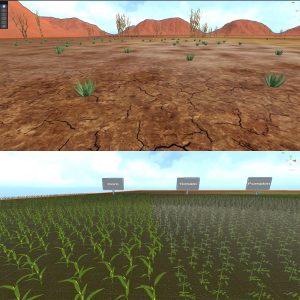
First place went to Agri-Verse, a student team whose interactive VR world asked users to manage crops during drought conditions. Team members Pooja Anandathirtha, Jonathan Cochenour, and Mahanyas Baira designed a scenario where users engaged with simulated crops in various weather and ecological conditions.
“The competition gave me a chance to learn VR design from scratch, collaborate with an amazing team and celebrate the top prize together, ” said Anandathirtha.
Judges cited the project’s completeness, usability, and clear connection to real-world challenges in agriculture as key reasons for its top ranking.
The second- and third-place teams were also recognized for innovative projects that addressed climate risks. Resilient Realities simulated emergency responses to floods and team Wild-Fire simulated the spread and suppression of wildfires under various conditions.
“The VR Challenge is equipping CSU students with in-demand digital skills for Colorado’s increasingly technology-focused job market,” said Brian Johnston, one of the judges and the Director of Workforce Development at Innosphere Ventures. “The quality and creativity of the projects really impressed me, and I’m excited to see how these students will contribute to the state’s workforce in the years ahead.”
High expectations
The VR Challenge brought together teams comprised of students from across campus, mixing skills and disciplines, pairing coders with artists, engineers and those focused on policy.
Unlike traditional weekend hackathons, the challenge ran over the course of the semester, so students had time to learn VR development, build functioning prototypes, and refine their ideas. Teams worked through the fundamentals of virtual reality, spent weeks testing and debugging their projects, and prepared for live demonstrations at the final event.
To recognize the time and effort involved, the challenge offered substantial prizes. The top three teams earned awards of $4,000, $2,000, and $1,000, and every student who completed the challenge received $200.
Climate resilience as a design brief
Virtual spaces are increasingly being used for education, design reviews, and public engagement. Organizers framed the challenge as a testbed for how tools like VR might help communities and decision-makers build a shared understanding of difficult problems before acting in the real world.
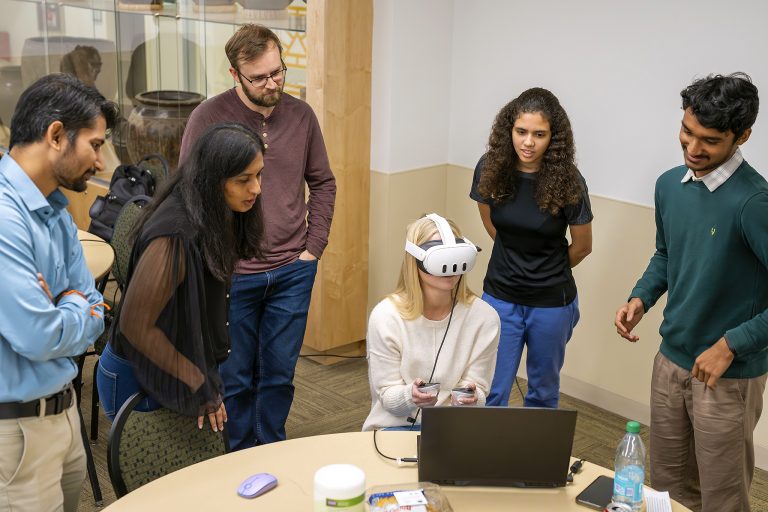
Teams used virtual reality to highlight different dimensions of resilience, from infrastructure and resources to human behavior. Visitors and judges moved through the room with headsets on, experiencing a range of perspectives on how climate risks can be understood and managed.
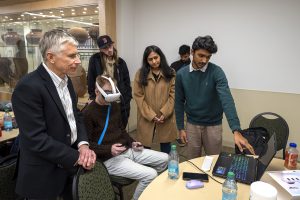
The challenge was led by Marie Vans, an associate professor in the Department of Systems Engineering. Under her direction, the event was designed not just as a technology competition, but as an exercise in systems thinking and teamwork.
“Given the time commitment, need for coordinated teamwork, and the intellectual demands of learning how to build virtual spaces, this was not an easy challenge to complete,” said Marie Vans, associate professor, CSU Systems Engineering. “I was proud of all those who completed their projects.”
Many thanks to the judges who volunteered their time and expertise!
Alan Rudolph, former CSU vice president for research.
Benjamin Friedman, lead data scientist at DLR Group.
Brian Johnston, director of workforce development at Innosphere Ventures.
Lauren Domingo, product designer at HP.
Steve Simske, professor of systems engineering.