E-DAYS 2025

E-Days 2025 - Mechanical Engineering

Engineering Days (E-Days) is a long-standing CSU tradition that allows senior undergraduate students the opportunity to showcase their senior design projects and senior practicum research. E-Days visitors include faculty, family, industry representatives, peers, and prospective students interested in exploring engineering.

The event will be held at the CSU Lory Student Center Plaza on Friday April 18th, 2025. 

For additional information, visit the Walter Scott, Jr. College of Engineering E-Days page.

Students
0
Projects
0

2026 Projects

Projects from other years: 2021 | 2022 | 2023 | 2024 | 2025 | 2026

Team photo

A Better Bison Swab

Project ID: 1374

Students:

Noah Cooley, Tareek Thomas, Will Kuhns
There are currently no effective or safe methods to swab bison for Mycoplasma bovis, a disease that can kill up to 30% of a herd. The inability to collect samples threatens the health and preservation of herds managed by the National Park Service, bison ranches, and indigenous tribes.
Department:
Department of Mechanical Engineering
Sponsors:
Dr. Danielle Buttke
Advisors:
Dr. Christian L’Orange
Team photo

Access Sensor Technologies

Project ID: 1374

Students:

Derek Duling, Kameron Jones, Beau Noland
Developed in collaboration with Access Sensor Technologies, the Automated Sample Analysis Platform builds upon an existing system designed to automate the analysis of air quality samples collected on Teflon filter disks. These disks capture particulate matter from locations of interest and must be manually weighed under tightly controlled environmental conditions to ensure accurate measurements. Our solution enhances the existing platform by implementing actively controlled temperature, humidity, and air filtration systems to improve data validity and repeatability. In addition, the system architecture is being redesigned in Python to eliminate reliance on costly, license-based LabVIEW hardware and software. Together, these improvements increase system reliability, reduce operational costs, and position our sponsor to expand the technology into new applications.
Department:
Department of Mechanical Engineering
Video presentation:
Link to project video
Advisors:
Team photo

Anheuser-Busch Ethanol Desulfurization

Project ID: 1374

Students:

Bethany Kantack, Erika Mathison, Zach Maxwell, Bennett Norton, Hajar Alattar, Aneece Douglas, Alec Brickl
At the Anheuser-Busch Fort Collins facility, the beer-making process produces 40,000 gallons per month of 199-proof ethanol as a waste stream. This ethanol contains 18 parts-per-million of sulfuric compounds, which is over the EPA regulations of three parts-per-million for fuel-grade ethanol. They are currently selling the ethanol at a loss, since they sell it for less than what it costs to ship it. The Anheuser-Busch Desulfurization Team was tasked with designing a process that will desulfurize the ethanol waste to a fuel-grade level. The final desulfurization design will allow them to sell the ethanol for a profit, while also improving the sustainability and environmental impact of desulfurizing the ethanol.
Department:
Department of Mechanical Engineering
Advisors:
Team photo

Anheuser-Busch Ethanol Waste Stream Repurposing

Project ID: 1374

Students:

ourke Adams, Cara Guydish, Manuela Rivera Villota, Ben Hayden, Michael Farah, Mallory Glenn, Caitlyn Morrill, Alex Tocco
Anheuser-Busch distills an ethanol stream from waste beer mandated by law to be separated from water and other compounds. Because of the rapidly changing ethanol market and the intensive energy processes required to purify their streams, Anheuser-Busch loses about 11 cents per gallon every time it sells off the ethanol, amounting to around 400,000 gallons per year. The Anheuser-Busch Ethanol Repurposing Team is researching and designing a process model to transform this ethanol waste stream into a more profitable and sustainable product for the company.
Department:
Department of Mechanical Engineering
Advisors:
Team photo

Composite Forge

Project ID: 1374

Students:

Jett Harrison, Jackson Hunter, Abner Itzep-Velasquez, Noah Thoele
This project focuses on characterizing the vibrational response of fishing rods under dynamic loading. No industry standard currently exists for frequency response, leaving manufacturers and end-users without a consistent way to evaluate or compare rods. This lack of standardization creates uncertainty for manufacturers developing products and for fishers selecting rods suited to their needs.
Department:
false
Video presentation:
Link to project video
Sponsors:
Dr. Thomas Murphey & Frank Paul King
Advisors:
Dr. Mitchell Stansloski
Team photo

CSUF Target Injector Gun

Project ID: 1374

Students:

Izaiah Carter, Robert Hartgenbush, Logan Mayne, Kai Owen, Savannah Sill,
This project is being developed for the university itself with this year's work being the beginning of an ongoing project that will ultimately result in a fusion power plant in northern Colorado. With a leading edge designed and manufactured gun on order from General Atomics in California taking two years to build, the university needs a simpler, but functional projectile injector to start testing and preparing for the final experiments.
Department:
Department of Mechanical Engineering
Video presentation:
Link to project video
Sponsors:
Dr. Reed Hollinger
Advisors:
Dr. Jorge Rocca
Team photo

CSUF-Calf House

Project ID: 1374

Students:

Dylan Frey, Caleb Tessely, Christopher Lambert
The first two months of life for dairy calves are critical for immune system maturation and growth. During this period, exposure to environmental stressors, such as heat stress and inadequate ventilation, can compromise calf health, welfare, and long-term productivity. Across many U.S. states, dairy calves are commonly housed individually in outdoor plastic shelters known as calf hutches. However, many of these designs lack adequate ventilation, temperature control, and airflow, often resulting in suboptimal environmental conditions for the calf. Working with CSU’s AgNext program and project sponsors Diego Manriquez Alvarez and Bianca Goncalves da Costa, our team aims to address the design challenges of current hutch models by developing an improved calf hutch that enhances ventilation, supports better thermal conditions, and remains manufacturing‑feasible and economically competitive. Our goal is to create a housing system that supports better environmental conditions for calves and ultimately contributes to improved animal well-being and lifetime productivity.
Department:
Department of Mechanical Engineering
Video presentation:
Link to project video
Advisors:
Team photo

Design-Build-Fly

Project ID: 1374

Students:

Harrison Payne, Sarah Vogler, Stuart Buecher, Colin Christensen, Claire Dalbec, Noah Guzman, Alex Ko, Kase Linden, Ryan Rodolph, Ethan Sterling
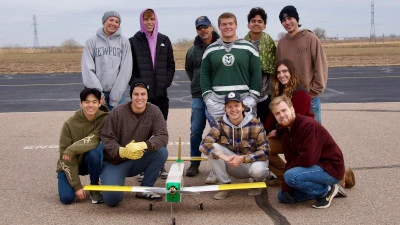
The Design Build Fly (DBF) team must design an RC aircraft capable of meeting mission requirements and maximizing competition scores at the internationally attended American Institute of Aeronautics and Astronautics (AIAA) DBF Competition by completing three arial missions and one ground mission.
Department:
Department of Mechanical Engineering
Video presentation:
Link to project video
Advisors:
Dr. Marco Ciarcia, Chris Douglas
Team photo

Dyal Fit-Adjustment System

Project ID: 1374

Students:

Dikchen Sherpa, Max Burdeen, Geoff Diaz, Jena Martin, Ryan Smith
The Dyal Fit-Adjustment System is a discreet, low-profile waist-adjustment mechanism designed to compensate for daily waist-size fluctuations of 1–2 inches. Sponsored by Bobby Reese of Dyal LLC, the project focuses on creating a durable, manufacturable solution that allows on-the-fly fit adjustments without adding bulk or compromising garment aesthetics. The goal is to improve comfort, consistency, and overall user satisfaction while enabling scalable integration into commercial apparel.
Department:
Department of Mechanical Engineering
Video presentation:
Link to project video
Sponsors:
Bobby Reese – Founder & CEO
Advisors:
Gaby Gritz Moya
Team photo

Formula SAE EV

Project ID: 1374

Students:

Amit Patel, Jose 'Daniel' Ortiz Valencia, Nathan Smith, Oscar Wenham, Carter Smith
The Colorado State University Formula SAE (FSAE) team is entering a landmark year, with 2025-26 marking the first time in nearly a decade that CSU will compete with both an internal combustion (IC) and an electric vehicle (EV). The EV team’s goal is to bring a fully electric racecar to competition for the first time in ten years, a step that represents a major advancement in the team’s technical development and competitive capabilities. Our senior design team, acting as a third-party contractor for CSU FSAE EV, is directly supporting this effort by taking on four critical projects within the EV program. These include packaging the tractive system to ensure safe and efficient integration of high-voltage components, designing and manufacturing new spindles to meet performance and durability demands, validating uprights carried over from the 2022–2023 combustion car, and developing the battery pack that will serve as the vehicle’s core energy source. Each project is tailored to specific sub team needs, ensuring that we address unique challenges effectively.
Department:
Department of Mechanical Engineering
Video presentation:
Link to project video
Advisors:
Dr. Chris Weinberger
Team photo

Galaxy Clamp Bike Rack

Project ID: 1374

Students:

Gerard Garcia, Gavin Howsden, Jayse Nakasone, Christopher Rivera
The Galaxy Clamp Bike Rack is a senior mechanical engineering design project sponsored by Joe Kovarik to improve the security and usability of rear-mounted bike racks. Current rack systems rely on straps that can be cumbersome and vulnerable to theft. Our team designed a ratcheting rear clamp mechanism inspired by handcuff systems to securely lock the rear wheel without straps. The design incorporates metal anti-theft features, integrated locking capability, and weather-resistant materials. Prototypes progressed from fully 3D-printed components to higher-fidelity manufactured assemblies. The final design is intended for patent protection and potential licensing to established bike rack manufacturers.
Department:
false
Video presentation:
Link to project video
Sponsors:
Joe Kovarik
Advisors:
Dr. Bonnie Roberts
Team photo

High-Speed Vacuum Transition Shutter

Project ID: 1374

Students:

Carly Shofer, Alex Henningfield, Safian Alam, Erik Jonasson, Erik Laursen, Derek Beureman, Anthony Lombardo
The client, Xcimer Energy, requires a high-speed shutter system to enable a laser beam to transition from a helium-filled chamber with a pressure of 1 atm to a downstream vacuum chamber at 10⁻⁴ torr. The shutter must be open for a minimum of 3 ms to allow the camera targeting to make adjustments to the laser before firing. Finally, it must achieve an airtight seal to prevent helium contamination of the vacuum chamber.
Department:
Department of Mechanical Engineering
Video presentation:
Link to project video
Sponsors:
Xcimer Energy Corporation
Advisors:
Team photo

Internal Combustion Engine Apparatus for the ASU Mechanical Engineering Department

Project ID: 1374

Students:

David Cody, Joel Martinez, Rivaldo Francisco
The Internal Combustion Engine (ICE) Project involves integrating a donated 3.6 L inline four engine with a water brake dynamometer to monitor engine torque, performance characteristics, and Otto cycle behavior in a live laboratory environment. The project includes the design and fabrication of the structural mounting system for both the engine and dynamometer, vibration isolation measures, and the selection and integration of instrumentation for accurate data acquisition. The objective of this project is to deliver a laboratory grade instructional apparatus to the Adams State University Mechanical Engineering Department that enables hands on demonstration of engine operation and quantitative Otto cycle analysis.
Department:
Department of Mechanical Engineering
Advisors:
Dr. Dan Olsen, Scott Clayton
Team photo

John Deere Ethanol Crank Case Ventilation System

Project ID: 1374

Students:

Blake Albi, Nick Becker, Antonio Garcia Posada, Peter O'Toole, Joshua Smith
The goal of this project is to design, build, and validate a benchtop test system that characterizes crank case ventilation (CCV) separator performance for a John Deere 4045HFC04 engine converted from diesel to ethanol. The bench will replicate engine conditions matching relevant flow, thermal, and mixture states to quantify oil ethanol separation efficiency and ethanol removal, and results will be correlated with engine testing to confirm relevance.
Department:
Department of Mechanical Engineering
Video presentation:
Link to project video
Sponsors:
Scott Chase
Advisors:
Dan Olsen
Team photo

Lincoln Electric Automation

Project ID: 1374

Students:

Payton Van Blaricom, Jack Herlihy, Abdul Rahman Al Kalbani, Mathias Bong
In a rigid fixture over a long length, the weight of the part and any misalignment in the headstock and tailstock can create large moment forces. These forces can put wear on the gearbox that drives the headstock, causing it to wear out over time, which limits the weight and length of parts that can be handled on these machines. Lincoln Electric Automation needs a solution to this problem so it can better meet the needs of its clients. This is a problem that affects Lincoln Electric as well as its clients and its machine operators.
Department:
Department of Mechanical Engineering
Video presentation:
Link to project video
Sponsors:
Lincoln Electric - Jeremy Meyer, Sholih Wood, Devin Dyke, Benjamin Less
Advisors:
Sohiel Fatehiboroujeni
Team photo

Long Range Drone Delivery System for Search-and-Rescue

Project ID: 1374

Students:

Jamisen Blackwell Benito Muniz Dain Romero
Design and develop a system for securing and transporting small packages utilizing a Search-and-Rescue drone for delivery of emergency supplies under our sponsor, Denslow Cattle Company.
Department:
Department of Mechanical Engineering
Advisors:
Team photo

Make-A-Wish

Project ID: 1374

Students:

Ella Olander, Nicholas Olmstead, Tyler Nordengren, Ian Haaf
Lamar’s World was created in partnership with Make-A-Wish to build something centered entirely around Lamar. He is a 13 year old bundle of joy who loves seeing doors open and close and lights turn on and off. This project encapsulates Lamar’s main enjoyments and combines them into not just a physical toy, but also a world he can explore. Utilizing Lamar’s excited arm movement, this project transforms that action into the start of an interactive experience. When Lamar moves his arms, a wearable sensor detects his motion and opens the door to his room. As the door swings open, his world comes to life — lights glow, familiar sounds play, and visuals reveal his favorite things. More than a sensory toy, this project turns a simple motion into independence, connection, and a world that responds directly to him.
Department:
Department of Mechanical Engineering
Video presentation:
Link to project video
Sponsors:
Kelcey Beckman
Advisors:
Dr. Wade Troxell
Team photo

MIGHTi Mushroom: Mobile Pasteurization System

Project ID: 1374

Students:

Emily Thomason, Daniela Ramos Tovar, Natalie Neils, Dustin Willis
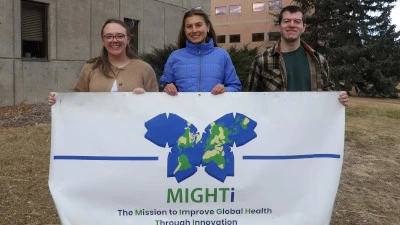
The MIGHTi Mushroom Pasteurization System is being developed to address malnutrition in Zambia by allowing year-round mushroom cultivation through safe and efficient substrate preparation. The Quality Function Development (QFD) has highlighted pasteurization effectiveness, energy efficiency, durability, and ease of use as the critical requirements guiding the design. Competitive benchmarking and tradeoff analysis confirm that a renewable energy power, weather-resistant system is necessary and feasible within the project constraints.
Department:
Department of Mechanical Engineering
Sponsors:
Bryan Wilson
Advisors:
John Mizia
Team photo

Opterus

Project ID: 1374

Students:

Eder Rubio, Riley Cronin, Joe Santos, Eric Buffington, Alex Winkler
Opterus, a company specializing in solar array hinges, needs a way to accurately test its High Strain Composite (HSC) hinges under conditions that replicate deployment in orbit. The current challenge is that no portable ground-based test rig exists that can both replicate orbital-like conditions and acquire precise Moment vs. Deployment Angle data. This is a problem because the performance of HSC hinges directly impacts the reliability of solar array deployment in space, which is critical for satellite and spacecraft functionality. The client is Opterus, and the stakeholders affected include aerospace companies, satellite operators, government space agencies, and end-users who rely on uninterrupted satellite services.
Department:
Department of Mechanical Engineering
Sponsors:
Jenna Commisso, Jack Sorensen, Thomas Murphey
Advisors:
Dr. Doug Fankell
Team photo

Ram Racing - FSAE IC

Project ID: 1374

Students:

Hudson Byers, Ben DeLorme, Tristin Durham, Ian Kelly, Kian Khatami, William Kingsley, Nathan Madachy, Keegan Rose, Danny Shireman, Noah Wood
Ram Racing, Colorado State’s Formula Society of Automotive Engineers (FSAE) club relies on senior design students to develop 8 different projects. Those projects include: Spindles, Uprights, Rear Wing, Chassis, Front Suspension, Steering Wheel, Active Aero, and Carbon Fiber Rod R&D. These components come together to construct Ram Racings 2026 competition vehicle that will compete at the internal combustion FSAE engineering competition in May at Michigan international Speedway against 120 other colleges. At competition the students projects will be put to the test in various static and dynamic events.
Department:
Department of Mechanical Engineering
Advisors:
Dr. Chris Weinberger
Team photo

ROAM Electric - Robotic Welding

Project ID: 1374

Students:

Ben Gujer, Greg Hider, Tamsin Izard, Dexter Shafer-White, Gage Steinke
Kenya and Africa have limited manufacturing capabilities, and outsourcing has proven to be unreliable. Manufacturing, especially welding, in Africa can also be unreliable and very unsafe. ROAM wants to expand, control, and improve their production with in-house manufacturing, so they can continue providing clean energy and transportation to Kenyans.
Department:
Department of Mechanical Engineering
Video presentation:
Link to project video
Sponsors:
ROAM Electric
Advisors:
Team photo

Rocketry and Mining Systems - CSU's NASA USLI Team

Project ID: 1374

Students:

Thomas Miller, Jack Stern, Daniel Fisher, Isa Fontana, Alex Benson, Lilly Perez, Tyler Shukert, Adam Ruelas, Ethan Milligan, Adrian Jimenez Ramos, Phillip Nelson, Connor Morgan
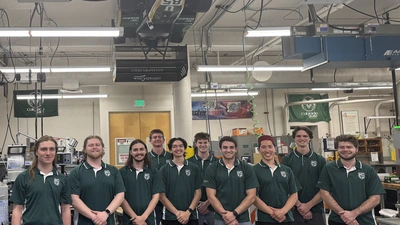
Rocketry and Mining Systems is a passionate team of Colorado State University engineers competing in this year’s NASA University Student Launch Initiative (USLI). Our core group of 12 senior leaders, 10 Mechanical Engineering majors, 1 Electrical Engineering major, and 1 Computer Engineering major, is supported by a dedicated team of underclassmen. Together, we’re working to bring CSU back to Huntsville, Alabama, and continue our tradition of innovation and excellence in rocketry. Follow along as we take on this challenge and aim high once again!
Department:
null
Video presentation:
Link to project video
Advisors:
Kari Cowden
Team photo

Solid Rocket Motor Test Stand

Project ID: 1374

Students:

Gavin McCommon, Alex Crispe, Alex Tongren, Michael Langston, Michael McKinnon, Jacob Jenkins, Kenta Koh
A means is required to obtain repeatable, validated combustion data for solid rocket motor (SRM) propellant strands under controlled pressurized conditions. The absence of accessible, small-scale, pressurized test facilities limits researchers' ability to rapidly characterize new propellant formulations and validate combustion models for design and safety assessments
Department:
Department of Mechanical Engineering
Video presentation:
Link to project video
Sponsors:
Walter Thompson
Advisors:
Walter Thompson
Team photo

Vectis Automation

Project ID: 1374

Students:

Preciosa Abril, Evan Sehnert, Ian Osborn, D'andre Rogers, Brandon Schreiner
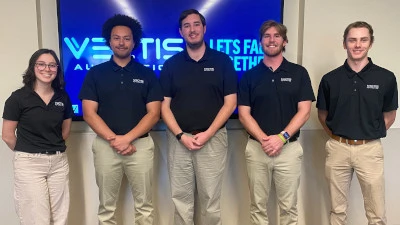
Vectis currently uses a cobot demonstration cart that is bulky, expensive to ship, and incapable of live welding. This cart is deployed in front of customers at trade shows to showcase software and system capabilities, but its limitations affect Vectis’ and Vectis employee’s ability to effectively demonstrate the value of its solutions.
Department:
Department of Mechanical Engineering
Video presentation:
Link to project video
Sponsors:
Drew Akey
Advisors:
Dr. Jide Williams
Team photo

Water Treatment Coagulation Control

Project ID: 1374

Students:

Robert (Hugh) McCurren, Josh Kates, Erik Olsson, Omar Ceesay, Max Goodrich, Artemio Tamayo, Dawson Carney, Luis Banuelos
Drinking water treatment plants often overdose their water with chemicals due to a lack of reliable and practical scientific tools available to help plant operators determine their plant's optimal chemical dose at any given time. A device that helps solve this problem, RoboJar, analyzes samples of water with various chemical doses and can be used to determine the optimal dose. Our team is incorporating the technology from RoboJar, a manual device, into an automated system that allows plant operators to optimize their chemical dose in a more convenient and efficient way. Our automated prototype, the FlocBot, decreases government spending on chemicals, creates less waste, and prolongs water treatment plant lifespans, all while helping to create safer, cleaner water.
Department:
Department of Electrical and Computer Engineering
Sponsors:
Entrepreneurship Project
Advisors:
Dr. Wade Troxell
Team photo

Waukesha P48SE Backfire Mitigation

Project ID: 1374

Students:

Vance Petersen, Mason Bowen, Nate Heumann, Johnny DeCelles, Peter Neuheardt
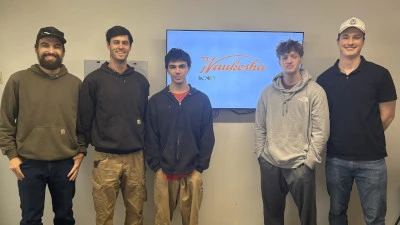
This project evaluates and redesigns the air-intake filtration system of the Waukesha Engines’ VGF P48SE engine. The existing system has experienced complete failures during rare backfire events, where high-pressure air, oil, and fuel are forced upstream into the intake, generating pressures up to 28 psi that can rupture filter media and expose the engine to damaging debris. These failures pose safety risks, increase repair costs, and can go undetected when operators are not present. The objective of this project is to develop a backfire mitigation system that can shield the air filter while maintaining airflow performance and ensuring compliance with industry standards. Building on prior concepts that proved inadequate, the design focuses on comprehensive mitigation of blowback effects, while extending service life, and reducing downtime for operators in diverse environments where reliable intake protection is critical.
Department:
Department of Mechanical Engineering
Video presentation:
Link to project video
Sponsors:
Waukesha Team: Michael Petry, Matt DeLise
Advisors:
Brian Johns
Team photo

Woodward 001

Project ID: 1374

Students:

Benjamin Perfors, Luke Langius, Jude Rudd, Brodie Halker, Mike Goyn
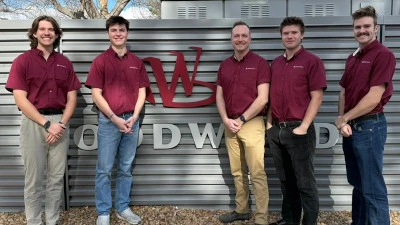
Woodward needs a way to address poor surface finish on their additive-manufactured aerospace parts and has tasked the team to design a process to achieve improved fatigue life, enhanced fluid flow properties, reduced FOD latching, and tighter geometric tolerancing. Addressing this need is critical for Woodward, as its aerospace customers demand high-tolerance components that meet strict reliability and safety standards. By developing a process that consistently improves surface finish, the project directly responds to customer requirements for extended fatigue life, improved flow efficiency, minimized FOD risk, reduced post-processing times, and adherence to geometric tolerancing. Meeting these outcomes will support Woodward’s ability to deliver high-performance aerospace components that satisfy both industry and government clients.
Department:
Department of Mechanical Engineering
Video presentation:
Link to project video
Sponsors:
Woodward
Advisors:
Dan Wise
Team photo

Woodward 002

Project ID: 1374

Students:

Carson Hobson, Brooke Carlson, Joe Pigati, Jacob Schoendube, Ella Martter
Our senior design team, Woodward-002, is focusing on improving efficiency in on-highway transportation. Shown in Figure 1, the transportation sector is among the least energy-efficient, with vehicles converting only about 24% of fuel energy into useful motion and rejecting the rest as waste heat. Despite this inefficiency, the sector accounts for approximately 76% of global petroleum consumption, making it a critical target for improvement. By investigating and implementing technologies that can reduce energy losses and enhance efficiency, our team aims to identify areas for meaningful performance gains.
Department:
false
Video presentation:
Link to project video
Sponsors:
Woodward
Advisors: