Facilities

Electrical and Computer Engineering Walter Scott, Jr. College of Engineering
Drone footage of main Engineering Building - home to ECE administrative offices, many ECE labs, study spaces, classrooms, and faculty offices.
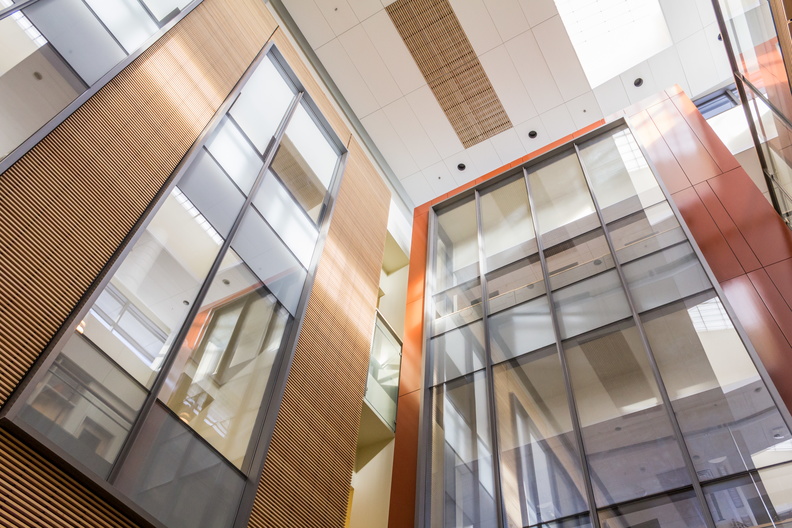
Houses multi-disciplinary laboratories and research offices, classroom spaces, and collaborative work areas.
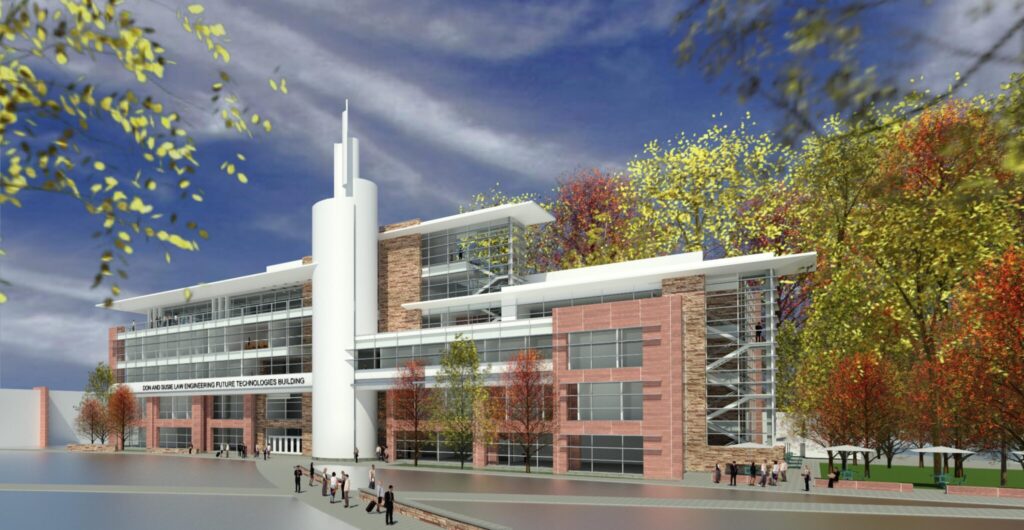
UNDER CONSTRUCTION: The Don and Susie Law Engineering Future Technologies Building will expand excellence in innovation and education.
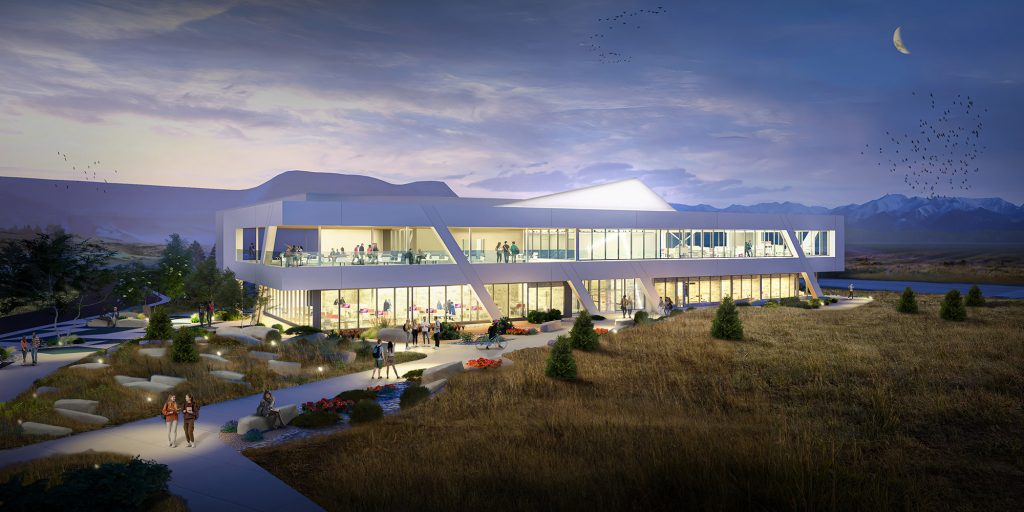
As a a global leader in laser innovation, CSU is constructing one of the most powerful laser facilities in the country. The Advanced Technology Lasers for Applications and Science (ATLAS) facility will serve as a premier destination for cutting-edge research, collaboration, and education.
CSU-CHILL is a center for research and development of weather radars in the CSU’s Departments of Electrical and Computer Engineering and Atmospheric Science. The facility’s research areas include microwave systems, signal processing algorithms, radar waveform design, FPGA data acquisition hardware, and radar system and network design.
Radars developed at the facility are deployed globally to support field campaigns in collaboration with partner research institutions and universities.
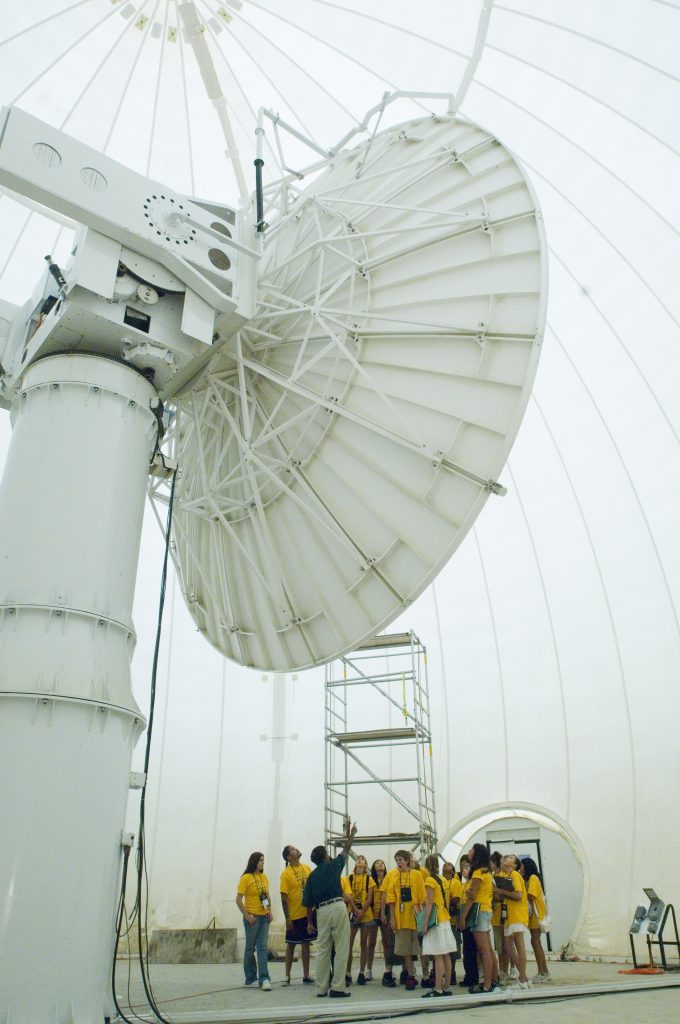
Bright researchers. Big ideas. Cutting-edge technologies. High-end instrumentation. Our centers and laboratories facilitate hands-on learning and make cutting-edge research possible.
The lab serves as a welcoming space for all engineering students to collaborate, experiment, create, and share. Join us in the CreatorSpace to connect with fellow students, explore your curiosity, and get creative.
Professor: Carmen Menoni
ERC B108/B312
Website
| This facility provides the infrastructure to grow and characterize ultrathin amorphous oxides which are used to engineer multilayer dielectric coatings. Two ion beam sputtering systems are used to deposit metal-oxides and metal-oxide mixtures. The facility is equipped with state-of-the-art optical characterization instrumentation which is used to assess the optical properties of thin films and multilayers. This Laboratory supports research on ultra-low internal friction for gravitational wave detectors as LIGO and on high performance near infrared coatings for Tera and Peta-Watt class lasers. |
Professor: Tony Maciejewski
Engineering C21
Phone: 970-491-2021
Website
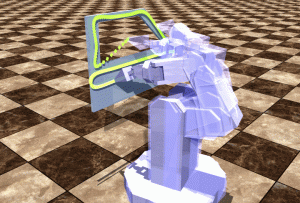
| This laboratory supports research activities in the simulation, analysis, design, and control of articulated motion generated by either biological or robotic systems. The emphasis is on the class of articulated systems that are kinematically redundant, and therefore capable of highly complex and dexterous motions. Current research activities include the development of failure tolerant robotic systems for use in hazardous or remote environments and the motion control of redundant robotic systems for additive manufacturing. |
Professor: Tom Chen
Phone: 970-491-7999
Location: Scott Bioengineering 169/180
Website
| The Bioanalytical Lab for Integrated Sensor Systems (BLISS) is a research group at Colorado State University that focuses on developing analytical devices integrating microelectronics, microfluidics, chemistry, and biology to address pressing challenges in medicine and global health. BLISS works jointly with a number of other research laboratories in the Department of Electrical & Computer Engineering, School of Biomedical Engineering, and Department of Chemistry, to engage in multidisciplinary research activities to bring new diagnostic and medical instrumentation technologies to the field. The interdisciplinary research activities include design and manufacturing of integrated circuits and integrated fluidic devices, device surface preparation, and test and characterization of devices in a variety of application settings. |
Professor: Kevin Lear
Engineering C07
| Research in the BOSS Lab centers on devices and systems for enhancing biomedical knowledge and applications. Many projects involve microfabricated sensors that combine optics (or photonics), electronics, and fluidics. Current topics under investigation include lab-on-a-chip cytometers incorporating optical and electrical impedance detection for use in parasitology and other diagnostics. A new area of investigation is the application of semiconductor and optical device simulation principles to neurophysiology and other areas of computational neuroscience. |
Professor: V. Chandrasekar
Engineering C209
Phone: 970-491-7981
Professor: V. Chandrasekar
Greeley
Phone: 970-491-6248
Website
Formerly located in Chicago, Illinois (thus the name CHILL), this facility is operated by the Department of Electrical Engineering and the Department of Atmospheric Science.
Professor: Anura Jayasumana
Engineering C203
Phone: 970-491-7855
Website
CNRL conducts research on a broad range of topics related to network science and network engineering. On-going projects include the detection of emerging patterns in networks, mining social networks, detection of domestic radicalization, graph databases, network sampling and reconstruction, network measurements and the Internet of Things (IoT). Prior projects include P2P networks, high-speed networking for radars, subsurface plume detection using sensor networks, performance analysis of networks, network measurements, and VLSI Testing.
Professor: Mahmood R. Azimi-Sadjadi
Location: Engineering C23
Phone: 970-491-1518
Website
| DSP lab is engaged in basic and applied research in the general areas of statistical signal/image processing and machine learning. Specific recent activities include: interactive sensing and active perception for optimal search and navigation to detect and classify targets using autonomous platforms, distributed multi-channel multi-platform sensing for collaborative decision-making, and machine learning for adaptive detection and classification with application to sonar. |
Professor: Branislav Notaros
Engineering B110
Phone: 970-491-2967
Website
This lab focuses on computational electromagnetics, higher order methods, integral equation methods, finite element methods, high-frequency methods, uncertainty quantification, adaptive refinement techniques, in-situ and remote sensing of snow, MRI-RF antennas/coils, EM/antennas/telemedicine systems for biomedical applications, and electromagnetics education. Its research is supported by grants from the NSF, DoD, NASA, and NIH.
Professor: Mahdi Nikdast
Engineering C03
Phone: 970-491-6401
Website
Current research activities in ECSyD laboratory focus on the integration and development of emerging electronic-photonic devices, circuits, systems, and architectures for interconnection networks, advanced high-performance computing and supercomputing systems, data centers, chip multiprocessors and manycore systems, and artificial-intelligence (AI) systems. We are developing new solutions to advance photonic systems-on-chip and data-communication systems while focusing on different aspects in such systems from design for energy efficiency and robustness to accurate device and system modeling and optimization, new electronic-photonic design-automation (EPDA) solutions and CAD tool development, and programmable optical-computing systems design and optimization. ECSyD laboratory is equipped with state-of-the-art workstations, servers, and silicon-photonic testing equipment, such as high-speed tunable lasers and an automated silicon-photonic testing station. ECSyD laboratory has a close collaboration with industrial partners at HPE (USA), CEA-LETI (France), Lumerical Inc. (Canada), Maple Leaf Photonics (USA), and NVIDIA (USA). Research activities of this laboratory are supported by government agencies such as the National Science Foundation (NSF).
Professor: Sudeep Pasricha
Location: Engineering C01
Website
| Research activities focus on software algorithms (including cutting-edge deep machine learning algorithms), hardware architectures, and hardware-software co-design for energy-efficient, fault-tolerant, real-time, and secure computing. These efforts target multi-scale computing platforms, including embedded and Internet of Things (IoT) systems, cyber-physical systems, mobile devices, and datacenters. |
Professor: Mario Marconi, Carmen Menoni
ERC B310/B312
Phone: 970-491-8297
This lab focuses on the implementation of imaging and interferometric tools at extreme ultraviolet wavelengths.
Professor: Jorge Rocca
ERC
Phone: 970-491-6796
Website
Professor: Steven Reising
Engineering C17
Phone: 970-491-5225
Website
This laboratory’s research focuses on the design and implementation of innovative microwave systems for remote sensing of the Earth’s oceans, land and atmosphere to monitor hazardous weather and global climate change. Students and researchers in this laboratory perform field measurements to study the physical relationship between sensors and environmental properties in order to improve inversion techniques and retrieval algorithms. Currently, this laboratory is combining expertise in monolithic microwave integrated circuit (MMIC) design and packaging with remote sensing experience to develop miniaturized, low mass and low power sensors that lend themselves to deployment aboard uninhabited airborne vehicles (UAVs) and small satellites. The first generation of these sensors is capable of operating in small networks to provide high spatial resolution 3-D humidity maps in all weather conditions. Research activities in this laboratory include systematic studies of microwave emission from breaking waves and foam on the ocean surface to increase the accuracy of satellite sensing of the ocean wind vector, temperature and salinity.
Professor: J. Rockey Luo
Engineering 24
Phone: 970-491-7411
Website
Conducts research projects in the areas of wireless communication, wireless networking, information theory and signal processing. Long term objective of the research is to bridge the gap between classical information theory and classical network theory, especially at the bottom several layers of communication networks. Typical research topics include network-related coding such as network coding and fountain coding, distributed channel coding, distributed medium access control algorithms, ad hoc networking, multiple antenna and cooperative communication networking, etc.
Professor: V. Chandrasekar
Engineering C109
Phone: 970-491-6758
Professor: Jorge Rocca
ERC B306
Phone: 970-491-8514
Professor: Jorge Rocca
ERC B208
Phone: 970-491-2249
Staff: Elaine Linde
Engineering C105
Phone: 970-491-6938
Staff: Elaine.Linde@colostate.edu
Engineering C107
Staff: Elaine.Linde@colostate.edu
Engineering C107