Welcome
to the Department of
Civil and Environmental Engineering!

The mission of the Department of Civil and Environmental Engineering is to prepare our graduates for creative and effective leadership in engineering practice, education, research, service, and engagement. Graduates shall have the ability to support engineering infrastructure, environmental sustainability, economic development, and quality of life with an interdisciplinary emphasis on responding to global changes in society and the environment.
The vision of the Department is to be among the world’s premier academic programs in Civil and Environmental Engineering, excelling in teaching, research, and professional service. The Department shall provide educational and research programs of the highest quality in both civil and environmental engineering.
The Department recognizes and represents Colorado State University’s commitment to the citizenry of Colorado, the nation, and the international community. In keeping with that commitment, the Department shall maintain nationally and internationally recognized programs of instruction, research, and outreach in areas of critical societal need including energy, environment, infrastructure, and water.
The Department shall support a diverse community of faculty, staff, and students in a collegial environment that fosters the development and professional achievements of each individual, groups of individuals, and success of the Department as a whole.
Online Civil Engineering graduate program in the nation (U.S. News and World Report Rankings, 2026)
Environmental Engineering graduate program in the nation among land-grant universities (U.S. News and World Report Rankings, 2025)
Civil Engineering graduate program in the nation among land-grant universities (U.S. News and World Report Rankings, 2025)
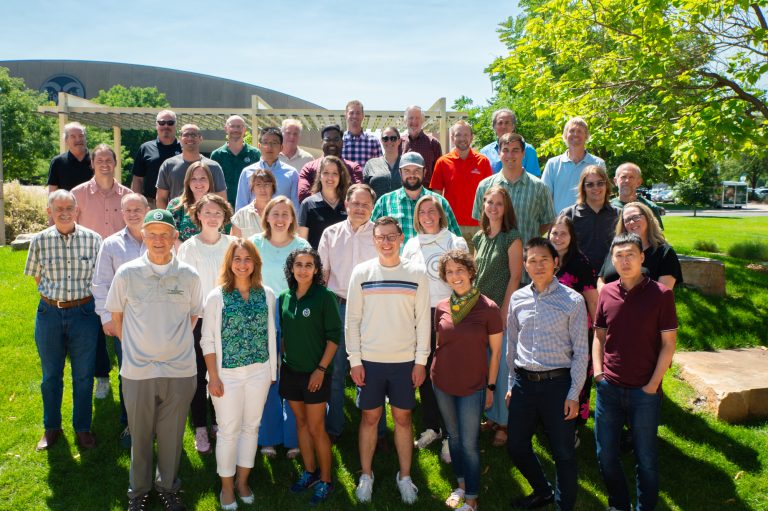
The Department of Civil and Environmental Engineering (CEE) at Colorado State University (CSU) in Fort Collins, CO, is proud to offer degrees in Civil Engineering, Construction Engineering, and Environmental Engineering. Our department is recognized both nationally and internationally for its research, education, and outreach programs, with our graduate programs ranking in the top 25 in the nation among land-grant universities. Our faculty are leaders in interdisciplinary research and education with annual research expenditures of $18.1M (FY24) across three broad focus areas: Environmental and Energy Systems; Infrastructure Systems; and Water Engineering and Science.
Located an hour north of the Denver metropolitan area, Fort Collins is a vibrant community of approximately 175,000 residents that offers the convenience of a small town with all the amenities of a large city. Fort Collins is situated on the Front Range of the Rocky Mountains with views of 14,000-foot peaks and offers access to numerous cultural, recreational, and outdoor opportunities. Fort Collins is routinely recognized nationally as one of the most desirable places to live in the USA:
#1 Best Place to Live in Colorado (Forbes 2022)
#6 Safest Cities for Cyclists (Your Local Security 2021)
#5 Top 10 Remote-Ready Cities in the US (Livability 2021)
#1 The Best Places to Live in America in 2020 (Market Watch)
#18 20 Safest Cities in Colorado (SafeWise 2020)
Fort Collins residents enjoy an excellent school system, expansive parks, natural areas, and trail systems. Learn more about Fort Collins and CSU.
We are proud of our Department, our College, our University, and where we live. We invite you to join us!
We welcome to our community as equal contributors all who share our goal to improve society regardless of race, ethnicity, culture, religion, sexual orientation, gender identity and expression, physical ability, age, socioeconomic status or nationality. We provide resources and support to cultivate positive academic and professional settings, empowering every member of our community to achieve their full potential.
We embrace Colorado State University’s Principles of Community as our core values: Inclusion, Integrity, Respect, Service, and Social Justice.
Whitney Borland was born in Holyoke, Colorado. He worked at the US Bureau of Reclamation from 1930-1942, and from 1942-1946, he served in the 10th Mountain Division in World War II. He returned to the USBR in 1946 and remained there until 1972. During his time at USBR, Borland worked at the hydraulics laboratory at CSU, using models to test the designs of several major dams. Later in his career, Borland made major contributions to understanding sediment yields from drainage basins, sediment transport in channels, and sedimentation in reservoirs.
The Borland Professor of Water Resources is held by Mazdak Arabi.
The Borland Professor of Hydrology is held by Frances Davenport.
The Borland Professor of Hydraulics is held by Chien-Yung Tseng.
The Faoro Professor in Water Resources is funded through a series of gifts made by Abraham B. Faoro and his wife Jean M. Faoro. Faoro earned his BS in civil engineering at CSU in 1932.
The Faoro Professor in Water Resources is held by Jeffrey Niemann.
Harold H. Short earned his BS in civil engineering at CSU in 1940. Short partnered with James G. Milne in Milne Ready Mixed Concrete Inc. and under his management, the company evolved from a small sand and gravel company into Flatiron Companies, which included paving, concrete, sand and gravel, and development businesses.
Contributions from Short and his family include the establishment of endowed scholarships in three colleges and land contributions. They made the first major gift to launch the Morgan Library campaign and in 1997, the Shorts gave $2 million to the engineering and physics campaign. This gift helped to fund the expansion and renovation of the Engineering building, create the Harold H. Short Civil Infrastructure Systems Laboratory, and establish the Infrastructure Chair in the College of Engineering.
The Harold H. Short Endowed Chair is held by John van de Lindt.
