WEES Seminar Fall 2025:
Aaron True
Aaron True

In both aqueous and terrestrial ecosystems, animals sense and exploit flow and odor cues embedded in complex environmental flows to improve fitness. These biological-chemical-physical interactions are modulated by fluid dynamic processes across a wide-range of spatiotemporal scales: understanding these interactions sheds light on diverse topics from ecosystems dynamics to brain function to engineered sensor design and bioinspired robotics. Robustly quantifying and reproducing naturalistic stimuli presents unique challenges in air and water which require quantitative approaches from experimental and numerical fluid dynamics. In this talk, I sample and present work from the past decade aimed at i. mimicking and quantifying naturalistic flow and odor stimuli in laboratory environments, and ii. quantifying organismal behavioral responses to these stimuli. I begin the talk with an overview of flow and odor landscapes which is grounded in fluid dynamics and seen through a sensory perspective. In the next part of the talk, I present several case studies. First, I discuss behavioral responses of marine zooplankters to fine-scale shear and chemical layers associated with thin planktonic layers, regions of enhanced biological productivity in nearshore ecosystems. Next, I discuss a novel, liter-scale experimental turbulence facility designed to produce planktonically-relevant hydrodynamic cues for studying diverse plankton- flow interactions and provide a detailed flow characterization of the facility. Last, I summarize several ongoing collaborative research projects from our lab aimed at studying the dynamics of terrestrial odor landscapes and the fluid mechanics of prototypical active sensing schemes for olfaction. Towards these aims, we are acquiring state-of-the art wind tunnel plume measurements using simultaneous planar laser-induced fluorescence (PLIF) and stereo particle image velocimetry (sPIV), numerically modeling honeybee antennae, and acquiring tomographic PIV measurements around a sniffing mouse model. I highlight recent findings and research directions within each project.
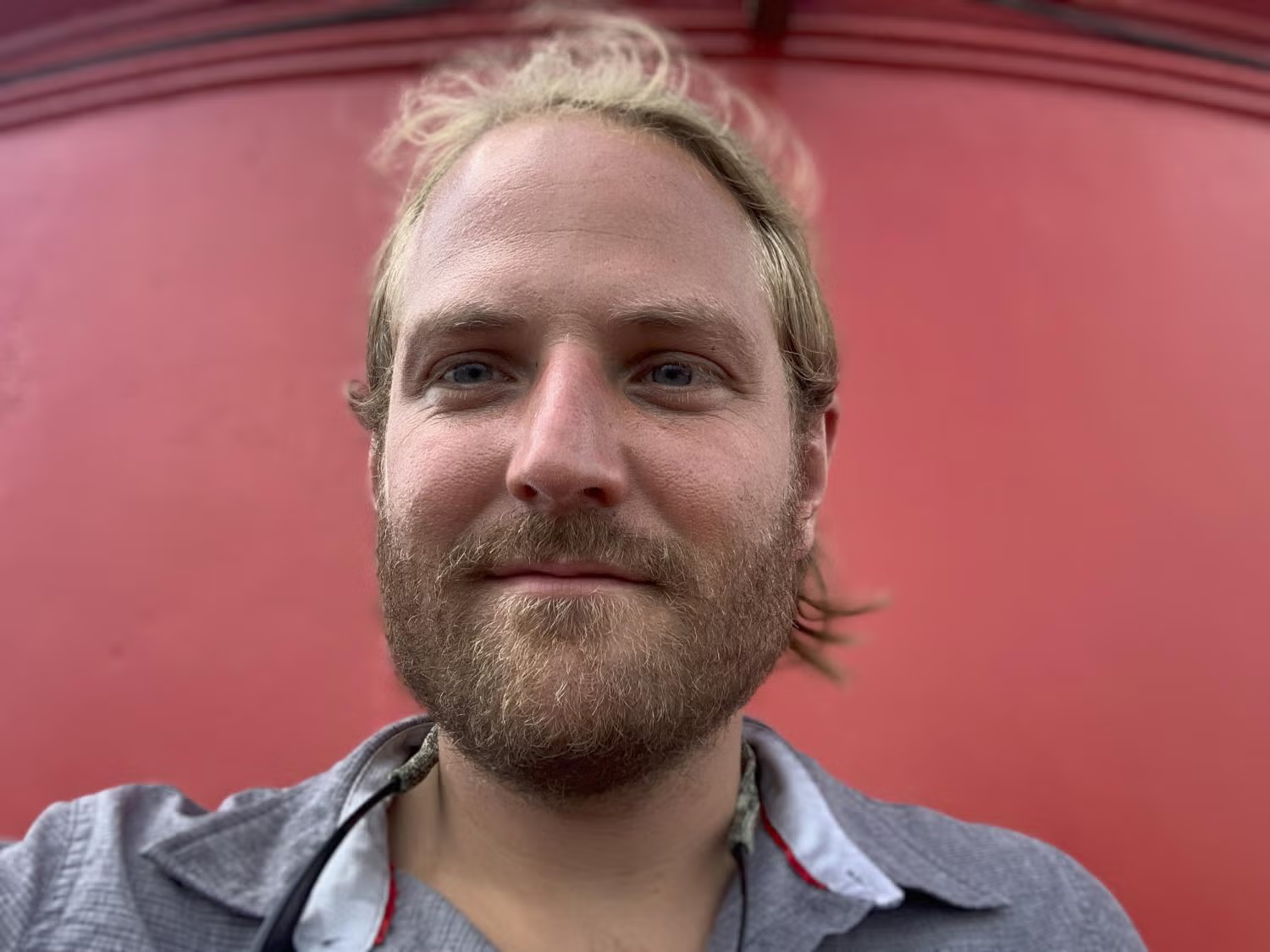
Dr. True is an Assistant Research Professor and Lecturer in the Department of Civil, Environmental, and Architectural Engineering at the University of Colorado Boulder. He received his PhD in 2014 in Civil & Environmental Engineering at Georgia Tech in Professor Don Webster’s group. His cross-disciplinary thesis work in environmental fluid mechanics and sensory ecology focused on biophysical interactions in thin plankton layers, regions of enhanced biological productivity in nearshore ecosystems. He used particle image velocimetry (PIV) and laser-induced fluorescence (PLIF) to characterize hydrodynamic and chemical stimuli associated with fine-scale shear and chemical layers and conducted biological assays with zooplankton to correlate organism behaviors to naturalistic sensory cues. He then joined the Ecological Fluid Dynamics (EFD) Lab of Professor John Crimaldi as a postdoctoral researcher at the University of Colorado Boulder. In this role, Dr. True studied a diverse set of environmental and ecological problems in fluid dynamics using quantitative tools from experimental and numerical fluid mechanics including PIV, PLIF, computational fluid dynamics (CFD), and high-speed imaging. Dr. True assumed a research faculty position at CU Boulder in January 2025 and continues his work as a core contributor to the Odor2Action (O2A) Network. O2A is an NSF NeuroNex project that brings together an interdisciplinary team of 16 PIs across the US, UK, and Canada dedicated to understanding how animals use odor to guide natural behavior. In his current role, he continues to advise graduate student researchers, foster collaborative research efforts, and teach undergraduate fluid mechanics and hydraulic engineering courses.