WEES Seminar Fall 2025:
Fahim Hasan
Fahim Hasan

Groundwater sustains much of the world’s irrigated agriculture. This reliance comes at a cost, as overextraction of groundwater has triggered widespread environmental consequences. However, the consequences and its actual use remain poorly monitored. To address these gaps, Fahim’s research integrates satellite and UAV remote sensing, artificial intelligence, and process-based modeling to develop scalable, data-driven frameworks for understanding and predicting groundwater dynamics across multiple spatial scales.
The talk will begin with a global perspective, highlighting Fahim’s work on mapping land subsidence induced by groundwater withdrawal, an environmental threat overlooked in many regions. This research identified the global hotspots of groundwater stress, revealing subsidence as a global indicator of unsustainable groundwater use. Transitioning from global scale, Fahim will present his current research on the Western United States, a region bearing the consequences of decades of groundwater overextraction. Here, Fahim will demonstrate how satellite data coupled with physics-constrained machine learning are used to quantify complex hydrologic fluxes and groundwater pumping in irrigated agriculture. Finally, the talk will showcase a framework of plant-scale evapotranspiration (ET) modeling, a key indicator of agricultural water use, driven by very high-resolution UAV data and energy balance model.
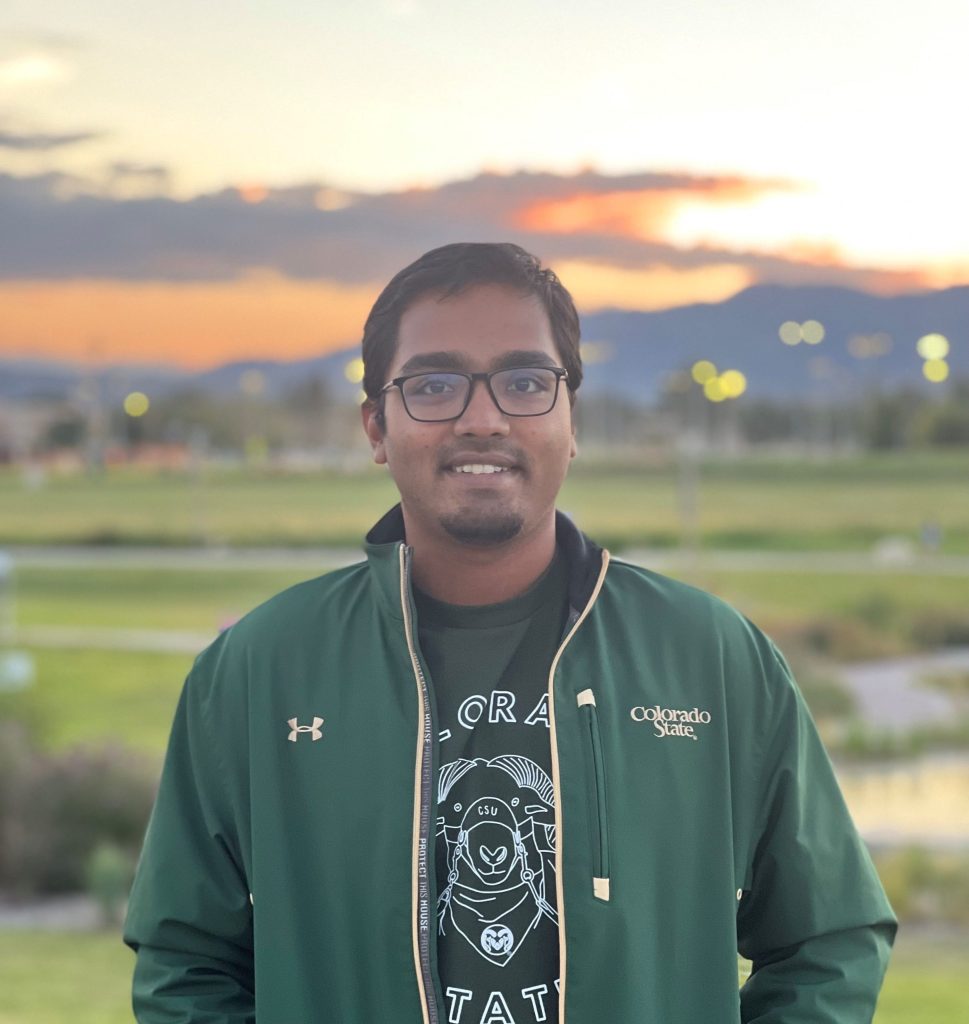
Fahim Hasan is a Ph.D. candidate in Civil and Environmental Engineering at Colorado State University under the supervision of Dr. Ryan Smith. His research centers on integrating remote sensing, machine learning, and statistical modeling to quantify and understand groundwater use in irrigated agriculture across the Western United States. Before joining Colorado State, Fahim earned his M.S. in Geological Engineering from Missouri University of Science and Technology and his B.Sc. in Civil Engineering from Bangladesh University of Engineering and Technology (BUET).
Fahim began his professional career in the water industry of Bangladesh. He has worked in both private and public sectors, with most of his tenure as an Assistant Engineer at the Bangladesh Water Development Board, where he contributed to national-scale water management and international water sharing treaties. Most recently, he completed Data Science internships at Syngenta and Bayer, two global ag-tech leaders. He aims to develop innovative, data-driven approaches for advancing sustainable water resource management, particularly in the emerging field of AgHydrology.