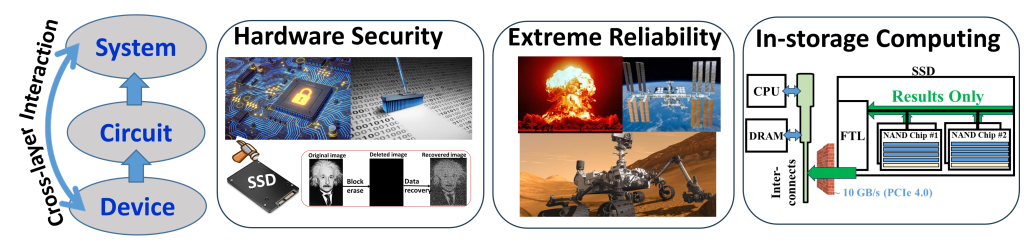
Our research spans the boundaries of electron devices and systems for addressing the challenges in hardware security and reliability, low power computing and smart sensor design.
We are always looking for motivated graduate and undergraduate students to work on interesting projects related to hardware security, extreme reliability, and emerging non-volatile memory systems.
We are open to collaborations with with groups from industry, academia, and national labs. If you think our expertise may help your project, please contact us to discuss possible collaborations.
Welcome to the Reliable and Assured Microelectronics (RAM) Laboratory at Colorado State University. The lab is founded and directed by Associate Professor Biswajit Ray. It is located at the CSU’s Main Campus in Fort Collins, Colorado.
The lab explores the fundamental science and engineering for next generation solid state storage technologies and systems. Even though storage technology has seen unprecedented growth in bit-density over the last few decades, emerging artificial intelligence and edge computing applications present new challenges related to security, resilience, and energy-efficiency. These challenges can only be addressed through innovative system design concepts that aptly utilizes the physical properties of storage media. The traditional storage system mainly relies on technology-agnostic algorithmic functions, often overlooking the intricate physical properties of the storage media. Our research endeavors aim to bridge this gap by developing a unique device-system interactive framework that will open-up new opportunities for enhancing resilience, security, and energy efficiency of future storage systems.
Based on fundamental sciences and engineering , we are exploring applications in various fields such as spaced based data centers, in-storage computing and supply-chain security of the storage chips.
