Our research focuses on laser-based measurement of gases, plasmas, and plasma-surface interactions for plasma science and electric propulsion applications. Interests also include laser ignition of engines, laser combustion diagnostics, high-power fiber delivery, and laser sensing for environmental and health applications.
Pre-Ionization Controlled Laser Plasma Formation
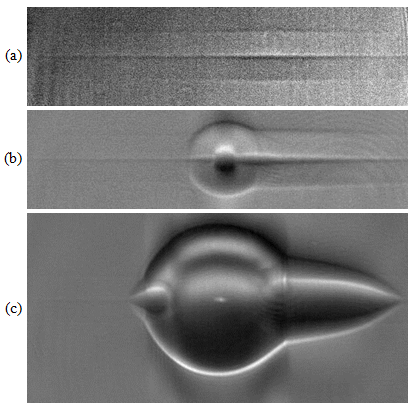
Laser based ionization sources have proven to have many benefits over conventional techniques such as spark plugs and igniters. However, plasma properties and associated ignition characteristics are largely uncontrollable. We are investigating the separation of the two stages of laser plasma formation (multiphoton ionization and electron avalanche ionization) by using two temporally resolved lasers operating at different wavelengths. By separating the ionization processes in this manner, we are able to access a wider range of plasma properties that were previously inaccessible. We then employ several diagnostic techniques such as Rayleigh and Thomson scattering to make 1-D measurements of the electron density and gas temperatures.
TALIF of Neutral Krypton in a Hollow Cathode and Hall Thruster Plasma
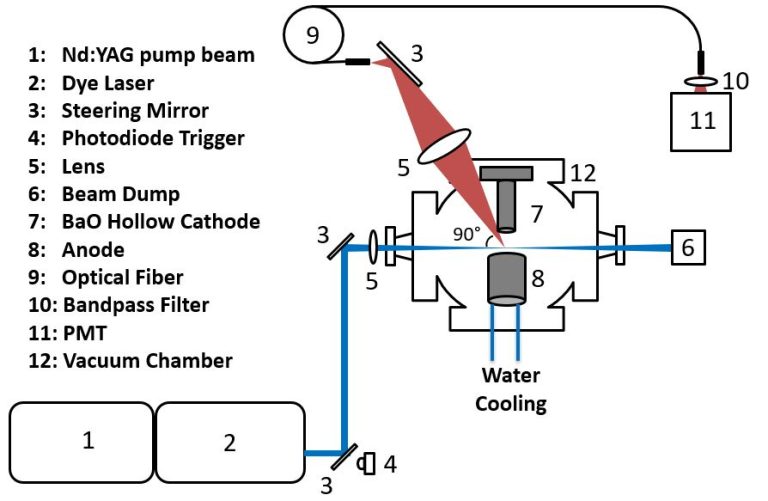
Neutral particle dynamics in the plume of a Hall Effect thruster play an important role in the device’s performance and lifetime. In particular, charge exchange reactions (CEX) between neutral particles and ions lead to sputtering of the thruster walls. CEX occurs more frequently in vacuum facilities where the pressures remain higher than that of space. To account for facility effects during lifetime tests, the density of neutral particles must be known. We are using Two-Photon Absorption Laser Induced Fluorescence (TALIF) to perform these measurements.
Laser Thomson Scattering
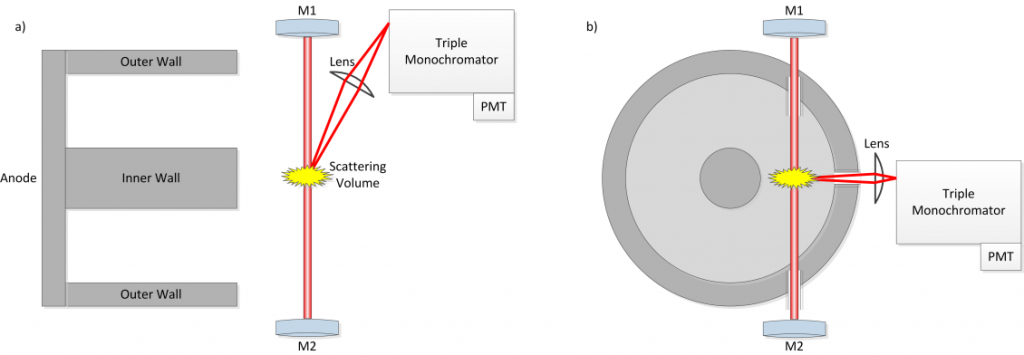
Interest in Hall thruster technology has continued to grow with emphasis on the development of high-power long life thrusters and improved understanding of plasma characteristics. Electrons play a key role in these devices; however available electron diagnostics are limited. To aid in the development of physics-based plasma models, improved capabilities for measuring electron number density (ne) and the electron energy distribution function (EEDF) are needed. Our group is developing Cavity Enhanced Thomson Scattering (CETS) to perform these measurements.
Cavity Ring-Down Spectroscopy of a BaO Hollow Cathode
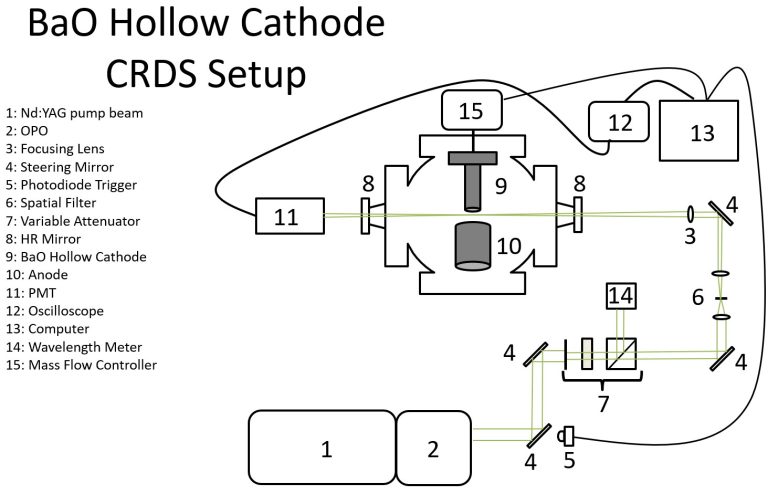
We are performing in situ Cavity Ring-Down Spectroscopy (CRDS) to measure Ba density in a BaO hollow cathode. The measurement includes both Ba neutrals and ions and will help validate existing plasma models of the cathode. Additionally, quantification of the Ba density will provide a more fundamental understanding of the erosion product transport and will inform future design and operation of BaO cathodes to meet the demanding requirements for future deep space missions.