
Research Interest
Multi-Agent Systems
Multi-agent systems (MAS in systems engineering extend the single-agent framework by incorporating multiple interacting agents, each with its policy \( \pi_i \). These systems are modeled using Partially Observable Stochastic Games (POSGs), where agents interact in a shared environment, making decisions based on partial observations \( O_i \).
\[ J(\pi) = \mathbb{E} \left[ \sum_{t=0}^\infty \gamma^t \sum_{i=1}^N R_i(s_t, a_t^i) \right], \]
where:
- \( N \): Number of agents in the system.
- \( \pi_i \): Policy of agent \( i \), defining its actions.
- \( R_i(s_t, a_t^i) \): Reward for agent \( i \) at time \( t \).
- \( \gamma \in [0,1] \): Discount factor balancing immediate and future rewards.
MAS are used to address large-scale, distributed problems where no single entity has full control or visibility. Examples include:
- Coordination: Distributed systems such as smart grids or traffic networks where agents optimize resources collectively.
- Optimization: Swarm robotics or logistics where agents minimize cost or time collectively.
- Adaptability: Systems-of-systems integration to ensure robust operation despite dynamic, uncertain environments.
Future Directions
The evolution of MAS research continues to focus on advancing scalability, interoperability, and ethical coordination among agents. Promising directions include:
- Scalable Architectures: Developing algorithms that ensure efficient decision-making as the number of agents and system complexity grow exponentially.
- Explainable Multi-Agent Systems: Introducing transparency in agent decisions to foster trust and accountability in high-stakes domains, such as healthcare and defense.
- Integration with Digital Twins: Using real-time simulations to model, test, and refine MAS deployments in critical industries like smart manufacturing and urban planning.
- Ethical Alignment: Exploring frameworks that ensure MAS adhere to societal norms, preventing unintended consequences from emergent behaviors.
- Cross-Domain Applications: Extending MAS frameworks to complex, interconnected domains such as space exploration, climate resilience, and disaster management.
Extending from Single-Agent Systems
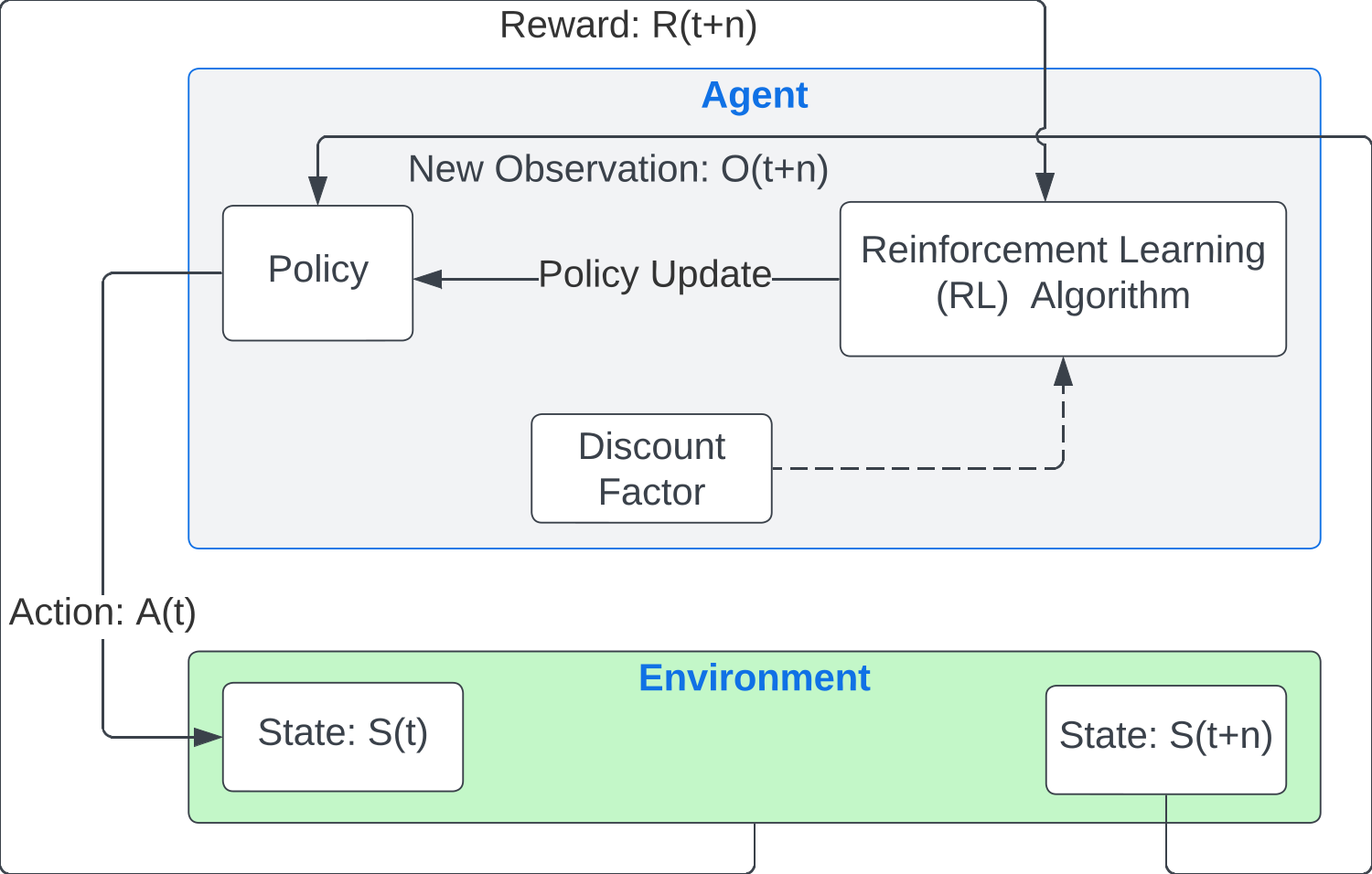
Building upon single-agent systems, multi-agent frameworks inherit foundational principles of agent-environment interaction. In single-agent systems, the focus remains on an agent optimizing its policy \( \pi \) to maximize the expected cumulative reward:
\[ J(\pi) = \mathbb{E} \left[ \sum_{t=0}^\infty \gamma^t R_t \right], \]
where:
- \( S_t \): Current state observed by the agent.
- \( A_t \): Action selected by the agent based on its policy \( \pi \).
- \( S_{t+1} \): Next state of the system after applying action \( A_t \).
- \( R_{t+1} \): Reward received after transitioning to the next state.
These principles are critical for applications such as autonomous robotics, decision support systems, and real-time adaptive control in engineering systems.
Artificial Intelligence in Systems
Artificial Intelligence (AI) in systems engineering focuses on leveraging AI-driven methodologies to analyze, predict, and optimize the behaviors of complex systems. By utilizing machine learning (ML), neural networks, and advanced decision-making frameworks, AI enhances system efficiency, adaptability, and scalability in real-world applications.
Optimizing System-Level Behavior
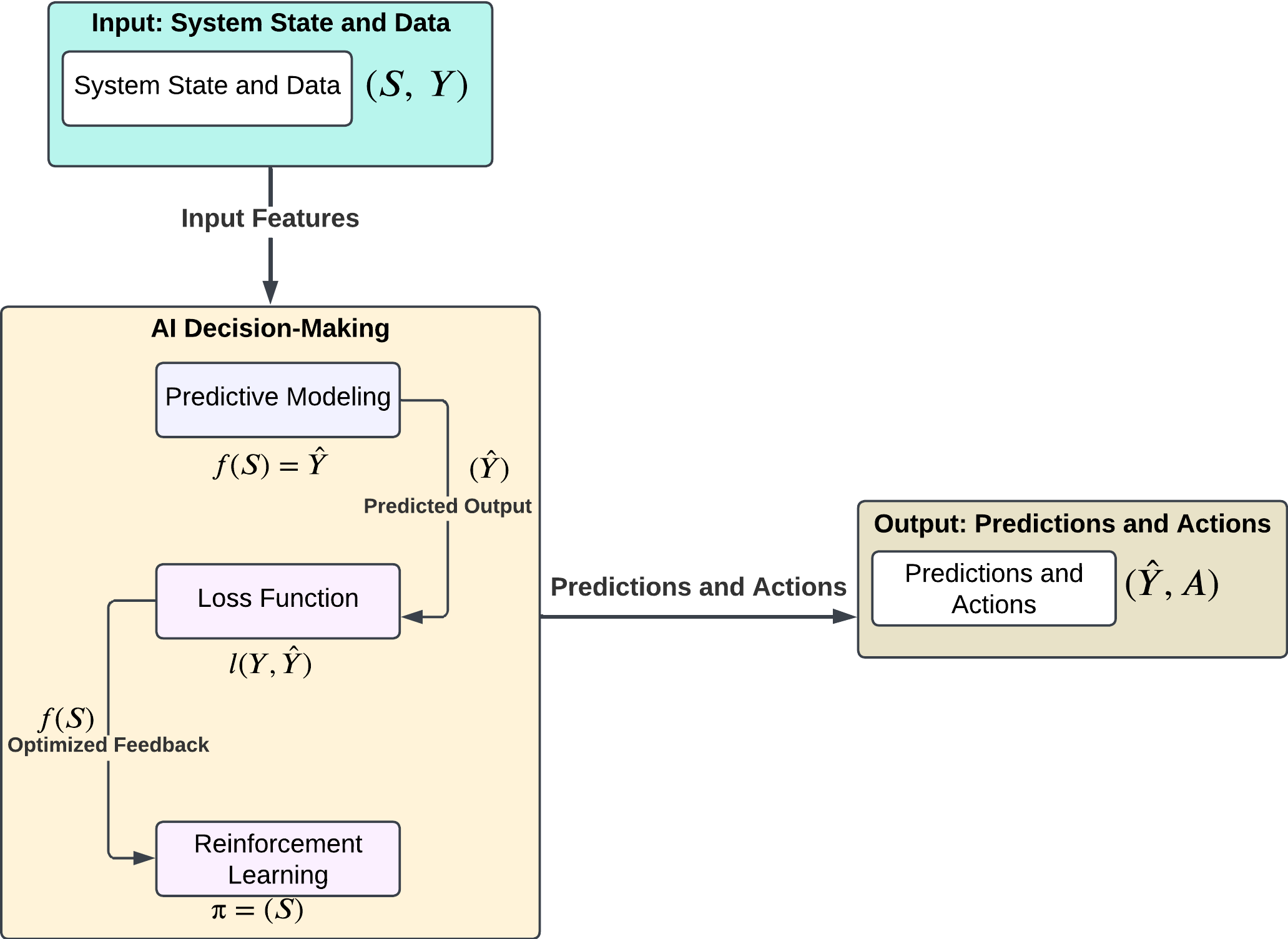
AI introduces intelligent decision-making processes into systems engineering by modeling system-level behaviors as optimization problems. For example, in predictive modeling, supervised learning techniques are applied to train models that map system states \( S \) to desired outputs \( Y \):
\[ f(S) = Y, \quad \text{where } f(S) \text{ is optimized using loss functions such as } \ell(Y, \hat{Y}), \]
where:
- \( S \): Input features representing the system's state.
- \( Y \): Target output (e.g., system performance metric).
- \( \hat{Y} \): Predicted output from the AI model.
- \( \ell(Y, \hat{Y}) \): Loss function that quantifies prediction errors.
Applications in Complex Systems
AI-driven solutions have been instrumental in addressing real-world challenges across various domains:
- Healthcare Systems Integration: Predictive analytics to streamline patient flow, optimize resource allocation, and enhance clinical decision-making.
- Transportation Systems: Reinforcement learning to optimize traffic flow, reduce congestion, and improve autonomous vehicle coordination.
- Semiconductor Manufacturing: Neural networks and unsupervised learning for defect detection, process optimization, and yield improvement.
Decision-Making Frameworks
Decision-making in AI-powered systems often relies on Markov Decision Processes (MDPs), where the goal is to find an optimal policy \( \pi \) that maps states \( S \) to actions \( A \), maximizing the expected cumulative reward:
\[ J(\pi) = \mathbb{E} \left[ \sum_{t=0}^\infty \gamma^t R_t \right], \]
where:
- \( R_t \): Reward at time \( t \), based on the system's performance.
- \( \gamma \in [0, 1] \): Discount factor for balancing immediate and future rewards.
Future Directions
Research in AI systems aims to advance explainable AI (XAI) for greater transparency, integrate multi-modal data sources for comprehensive insights, and develop scalable solutions that bridge the gap between theoretical advancements and real-world implementations.
System-of-Systems Integration
System-of-Systems (SoS) integration focuses on designing innovative architectures and frameworks to manage and optimize the interaction of independent systems that collaborate to achieve overarching objectives. This research addresses challenges of interoperability, scalability, and resilience in large-scale, complex systems where constituent systems retain their autonomy while functioning as part of a unified whole.
Architectural Frameworks for SoS
SoS architectures are categorized into Directed, Acknowledged, Collaborative, and Virtual frameworks, each addressing varying degrees of managerial control and cooperation. A key challenge is ensuring seamless communication and resource sharing between systems with heterogeneous designs, operating protocols, and objectives.
Mathematical Modeling of SoS
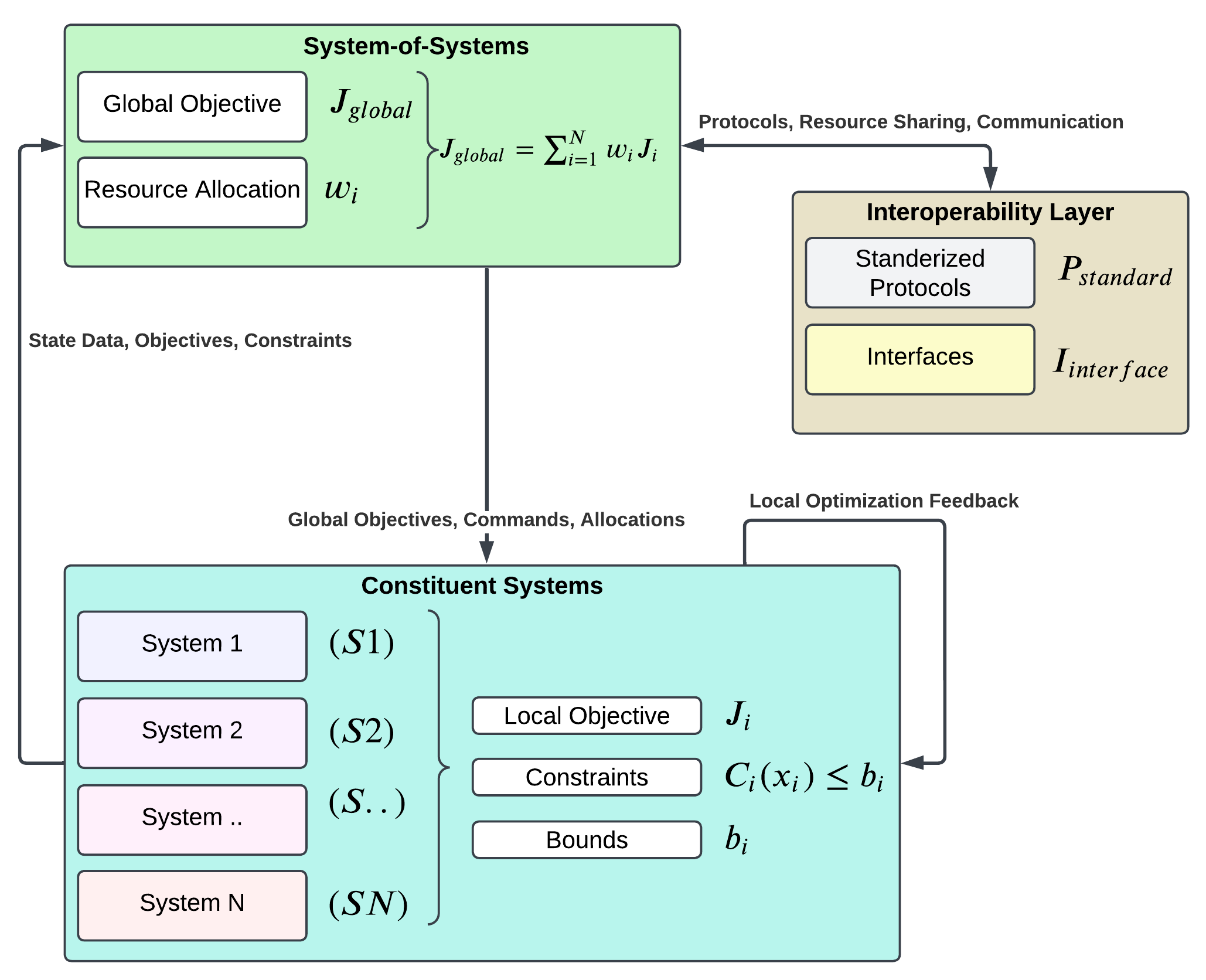
The integration of SoS can be modeled as an optimization problem where the global objective \( J_{\text{global}} \) is maximized while satisfying constraints for individual systems:
\[ J_{\text{global}} = \sum_{i=1}^N w_i J_i, \quad \text{subject to } C_i(x_i) \leq b_i, \, \forall i, \]
where:
- \( J_i \): Local objective function of system \( i \).
- \( w_i \): Weight representing the priority of each system's objective.
- \( C_i(x_i) \): Constraints for system \( i \).
- \( b_i \): Resource limits or operational bounds for system \( i \).
Applications in Real-World Domains
SoS integration has transformative applications in various domains:
- Smart Cities: Integration of transportation, energy, and public safety systems to enhance urban sustainability and resilience.
- Energy Grids: Coordination of distributed energy resources, such as renewable energy systems and microgrids, for efficient and reliable power distribution.
- Aerospace Systems: Collaboration between autonomous drones, satellites, and ground control systems for mission-critical operations.
Interoperability and Adaptability
Achieving interoperability in SoS requires the development of standardized communication protocols and interfaces, enabling seamless data exchange across systems. Adaptability is achieved through modular designs and dynamic reconfiguration strategies, allowing the SoS to respond effectively to changes in operational conditions or system failures.
Future Directions
Emerging research in SoS integration focuses on incorporating digital twin technologies, predictive analytics, and AI-driven optimization to enhance real-time decision-making, reduce operational risks, and improve system-level resilience. These advancements aim to bridge the gap between theoretical research and large-scale practical implementations.
Agentic AI
Agentic AI explores the integration of agency into artificial intelligence, focusing on systems that exhibit autonomy, adaptability, and proactivity in decision-making. These AI systems are designed to operate in dynamic environments while aligning their actions with human values, ethical considerations, and long-term societal goals.
Core Principles of Agentic AI
At its core, Agentic AI is guided by three principles:
- Autonomy: The ability of AI systems to make decisions independently based on their understanding of the environment and predefined goals.
- Adaptability: Dynamic learning and evolution of decision-making strategies to accommodate changing conditions or unexpected scenarios.
- Alignment: Ensuring that AI systems' objectives, behaviors, and outcomes remain consistent with human values and ethical frameworks.
Mathematical Framework for Agentic Decision-Making
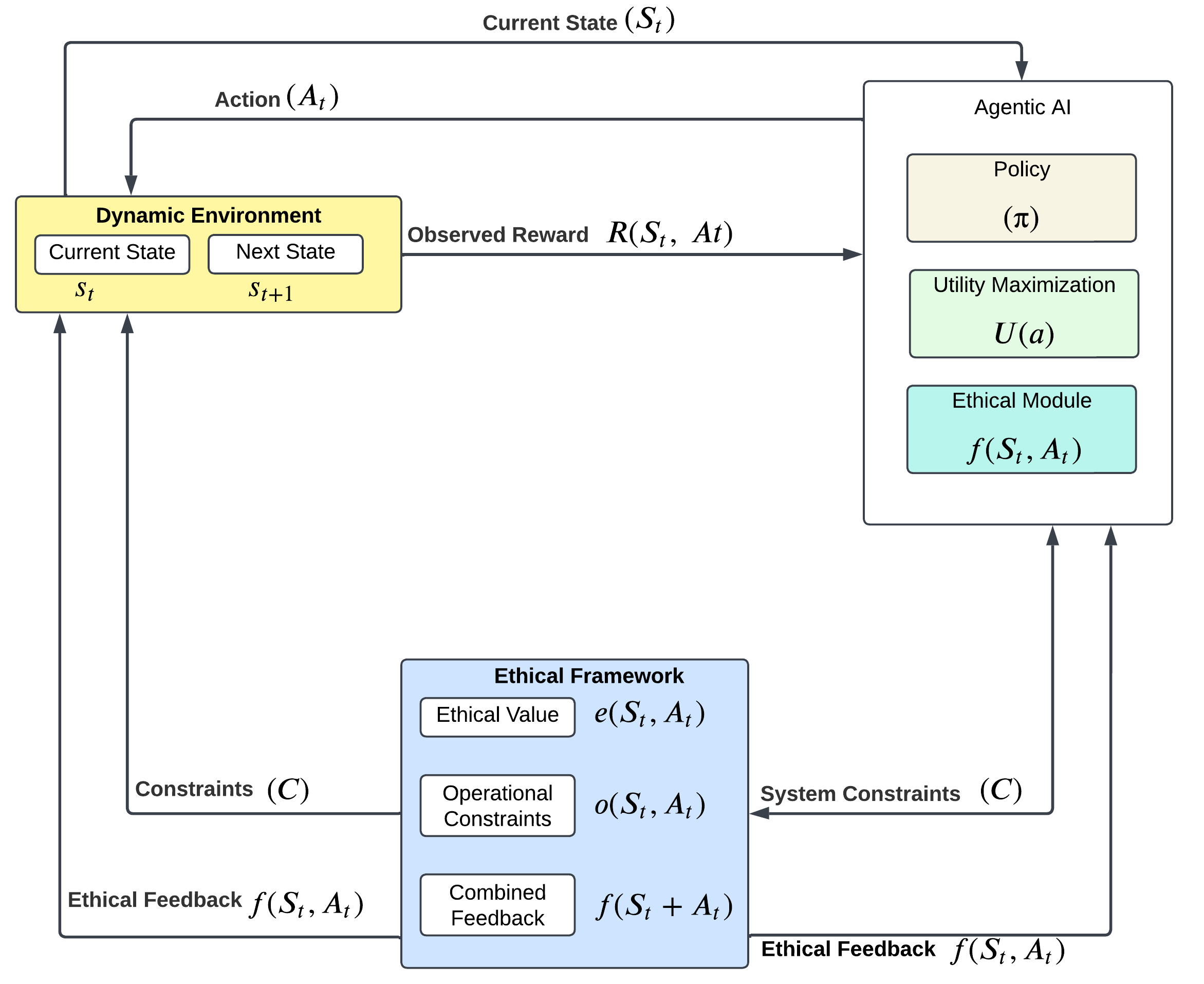
Agentic AI systems are modeled to maximize utility functions while maintaining ethical and operational constraints:
\[ U(a) = \sum_{t=0}^\infty \gamma^t R(s_t, a_t) \quad \text{subject to } E(f(s_t, a_t)) \leq C, \]
where:
- \( U(a) \): Utility function representing the cumulative reward of actions \( a \).
- \( R(s_t, a_t) \): Reward function for taking action \( a_t \) in state \( s_t \).
- \( \gamma \): Discount factor balancing immediate and future rewards.
- \( E(f(s_t, a_t)) \): Expected ethical impact function of the state-action pair.
- \( C \): Constraint threshold ensuring ethical compliance.
Applications of Agentic AI
Agentic AI has transformative potential across multiple domains:
- Healthcare: Autonomous AI agents that assist in diagnostics, personalized treatment planning, and patient monitoring while adhering to ethical medical guidelines.
- Transportation: Adaptive navigation systems in autonomous vehicles that prioritize safety and sustainability.
- Aerospace: AI systems that independently manage space missions, adapt to unforeseen conditions, and ensure mission success.
- Energy Systems: AI agents that optimize energy consumption and distribution while balancing economic and environmental considerations.
Ethical Challenges and Opportunities
Designing Agentic AI presents unique challenges, including defining universally acceptable ethical constraints, resolving conflicts between competing objectives, and ensuring transparency in decision-making processes. However, these challenges also offer opportunities for innovation, such as developing explainable AI models, formalizing ethical impact assessment frameworks, and fostering interdisciplinary collaboration to address societal concerns.
Future Directions
Advancing Agentic AI requires integrating reinforcement learning, multi-agent coordination, and human-in-the-loop systems to enhance decision-making capabilities. Emerging research focuses on leveraging digital twins, causal inference, and value alignment techniques to bridge the gap between theoretical principles and practical applications.