
Key Highlights
Research Interest
Exploring advanced methodologies in multi-agent systems, artificial intelligence, and systems engineering to address complex challenges through impactful and innovative solutions.

Google Scholar
Access a comprehensive collection of my patents, publications, and citations, showcasing my research contributions and collaborations within the academic community.

ORCID
Explore a verified record of my research outputs and professional activities through my ORCID profile. Gain insights into my academic journey, collaborations, and achievements.

Education and Industry Expertise
Bridging academic knowledge and industry insights to advance technology and engineering practices, fostering impactful projects and transformative solutions.
Recent Contributions
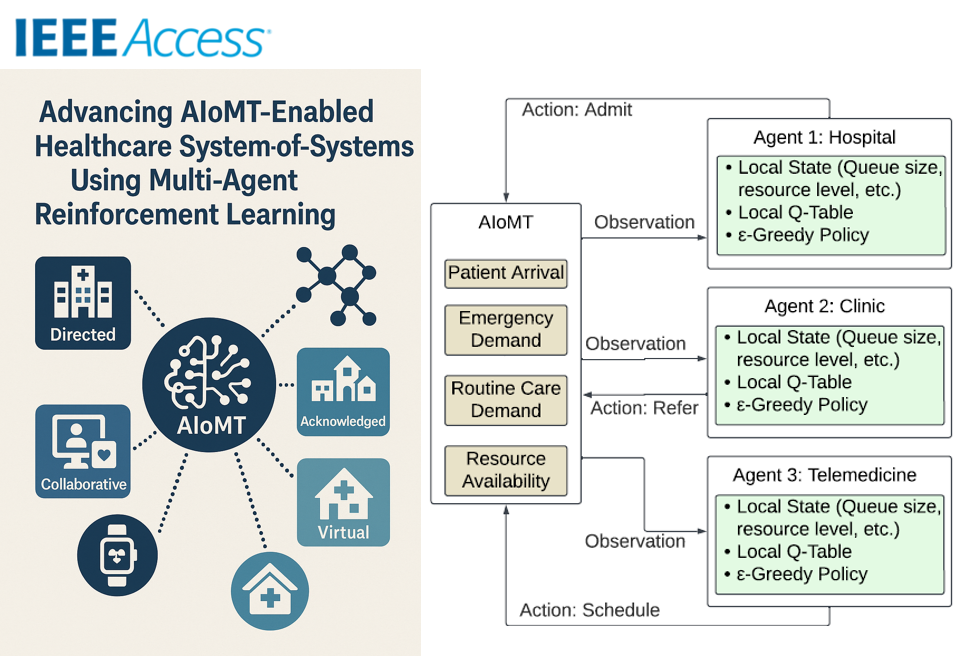
Advancing AIoMT-Enabled Healthcare System-of-Systems Using Multi-Agent Reinforcement Learning
This work presents a novel framework integrating Multi-Agent Reinforcement Learning (MARL) with System-of-Systems (SoS) principles to enhance healthcare coordination. Six heterogeneous entities—hospitals, clinics, telemedicine, wearables, rural centers, and virtual triage—are organized into four coordination models: Directed, Acknowledged, Collaborative, and Virtual. Within an AI-enabled Internet of Medical Things (AIoMT) environment, agents autonomously optimize resource allocation, cooperation, and service efficiency through decentralized learning.
A. Sheikh, and E. K. P. Chong, "A Multi-Agent Reinforcement Learning Framework for AIoMT-Enabled Healthcare SoS Coordination”, IEEE Access, vol. TBA, no. TBA, pp. 1--1, August 2025. DOI: 10.1109/ACCESS.2025.3596921
Read More >>
Unpacking the Research: Advancing AIoMT-Enabled Healthcare System-of-Systems Using Multi-Agent Reinforcement Learning
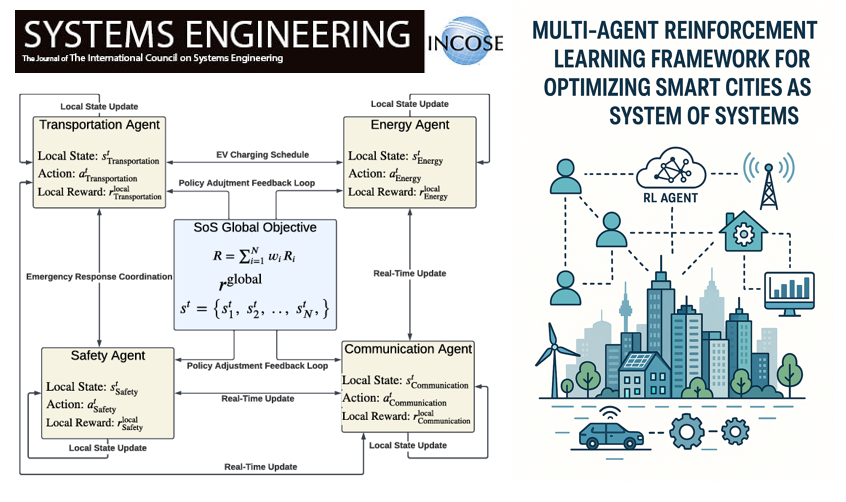
Multi-Agent Reinforcement Learning Framework for Optimizing Smart Cities as System of Systems
This research introduces an innovative framework that combines Multi-Agent Reinforcement Learning (MARL) with traditional Systems of Systems (SoS) methodologies to address existing limitations. Unlike conventional SoS approaches, the framework harnesses MARL’s decentralized decision-making and augmented reward mechanisms to dynamically align individual agent objectives with overarching SoS goals. This approach effectively tackles critical challenges such as inter-system coordination, scalability, and adaptability, offering a cohesive solution for managing complex interactions and emergent behaviors in smart city systems. The framework ensures both traceability and adaptability, enabling efficient, coordinated, and real-time responses to dynamic environmental changes.
A. Sheikh, and E. K. P. Chong, "Multi-Agent Reinforcement Learning Framework for Optimizing Smart Cities as System of Systems, Systems Engineering, Wiley, vol. TBA, no. TBA, pp. 1--1, July 2025. DOI: 10.1002/sys.70006
Read More >>
Unpacking the Research: Multi-Agent Reinforcement Learning Framework for Optimizing Smart Cities as System of Systems

Artificial Intelligence-Driven Optimization for Three-Dimensional Integrated Circuit Manufacturing: A System of Systems Framework
This paper introduces an Artificial Intelligence (AI)-driven framework for optimizing 3D Integrated Circuit (3D-IC) manufacturing through a System of Systems (SoS) approach. Our framework integrates defect detection, process optimization, and electrical failure prediction using advanced methodologies, notably Convolutional Neural Networks (CNNs), Random Forest Classifiers, and Long Short-Term Memory (LSTM) networks.
By dynamically aligning subsystem outputs with global manufacturing objectives, our framework addresses key challenges in Through-Silicon Via (TSV) formation, defect reduction, and yield enhancement.
A. Sheikh, and E. K. P. Chong "Artificial Intelligence-Driven Optimization for 3D Integrated Circuit Manufacturing: A System of Systems Framework," IEEE Transactions on Components, Packaging and Manufacturing Technology, vol. TBA, no. TBA, pp. 1--1, March 2025. DOI: 10.1109/TCPMT.2025.3549707
Read More >>
Unpacking the Research: AI and 3D Integrated Circuit Manufacturing Optimization

Enhancing Defect Detection in Circuit Board Assembly Using AI and Text Analytics for Component Failure Classification
This paper investigates the application of text analytics for defect detection and characterization in electronics manufacturing of printed circuit board assembly by analyzing structured and unstructured textual data from circuit board and packaged chip testing. This research leverages text analytics to transform these descriptive narratives into structured, actionable data, thereby improving the precision and efficiency of defect identification. A Naïve Bayes model was employed for classification, and natural language processing (NLP) techniques were utilized to extract meaningful patterns from defect descriptions.
A. Sheikh, E. K. P. Chong, and S. J. Simske "Enhancing defect detection in circuit board assembly using AI and text analytics for component failure classification," IEEE Transactions on Components, Packaging and Manufacturing Technology, vol. 14, no. 10, pp. 1881--1890, October 2024. DOI: 10.1109/TCPMT.2024.3453597
Read More >>
Unpacking the Research: AI and Text Analytics for Failure Classification
Evaluating Artificial Intelligence Models for Resource Allocation in Circular Economy Digital Marketplace
This study evaluates multiple machine learning (ML) models to address the complexities of resource allocation, demand-supply matching, and dynamic pricing in volatile Circular Economy (CE) digital marketplaces. Without fine-tuning hyperparameters, we assessed the baseline performance of diverse AI algorithms, uncovering insights into their strengths and limitations for managing unpredictable market conditions.
This work establishes a foundational framework for integrating AI into CE marketplaces, showcasing its role in supporting sustainable resource efficiency and decision-making. It also emphasizes the importance of fairness, transparency, and ethical considerations for responsible AI deployment in sustainability contexts.
A. Sheikh, S. J. Simske, and E. K. P. Chong, "Evaluating Artificial Intelligence Models for Resource Allocation in Circular Economy Digital Marketplace," Sustainability, vol. 16, no. 23, paper 10601, December 2024. DOI: 10.3390/su162310601
Read More >>
Listen to the Key Takeaways: AI Model Evaluation for Circular Economy
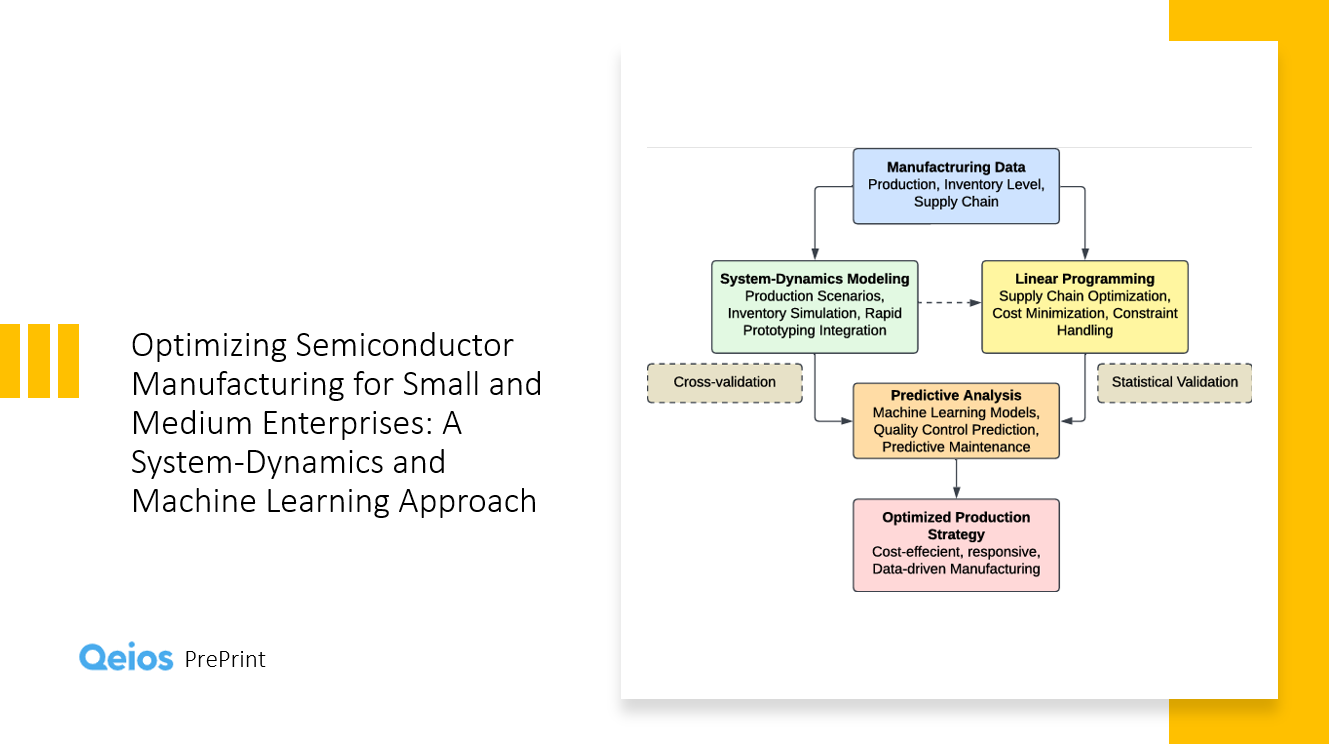
Optimizing Semiconductor Manufacturing for Small and Medium Enterprises: A System-Dynamics and Machine Learning Approach
This paper presents an integrated optimization framework for low-volume semiconductor manufacturing tailored to Small and Medium Enterprises (SMEs). Combining system-dynamics modeling, linear programming, and predictive analytics, the framework enhances supply chain efficiency and production planning. Python-based simulations and cross-validated machine learning models support cost-effective decision-making and rapid prototyping. Through correlation analysis, ANOVA, and comparative evaluation, the framework demonstrates measurable gains in both efficiency and adaptability, offering actionable strategies for addressing SME-specific constraints.
A. Sheikh, and E. K. P. Chong "Optimizing Semiconductor Manufacturing for Small and Medium Enterprises: A System-Dynamics and Machine Learning Approach," Qeios, vol. TBA, no. TBA, pp. 1--1, March 2025. DOI: 10.32388/EOQ6MJ.2
Read More >>
Unpacking the Research: AI Driven Semiconductor Manufacturing Optimization
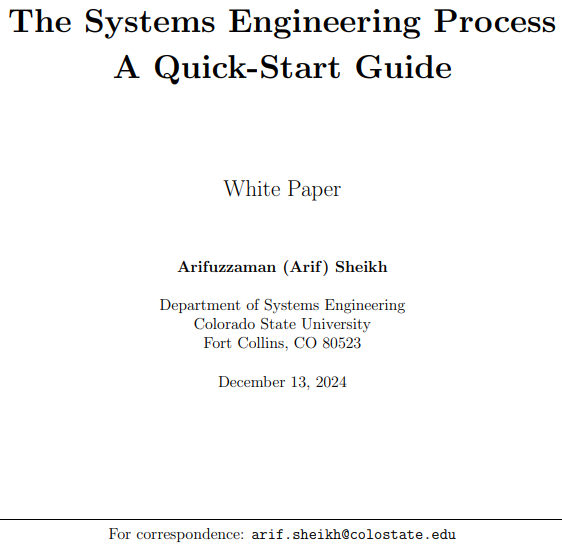
Quick-Start Guide: Systems Engineering
This white paper outlines a comprehensive framework for the foundational systems engineering process, starting from identifying needs to implementing robust system specifications. It offers practical tools and insights for managing complexity, ensuring traceability, and enhancing stakeholder satisfaction. Designed for academia and industry, this guide simplifies systems development and delivers impactful project outcomes.
Free Download (PDF) >>
Listen to Audio Highlights of Systems Engineering Quick-Start Guide
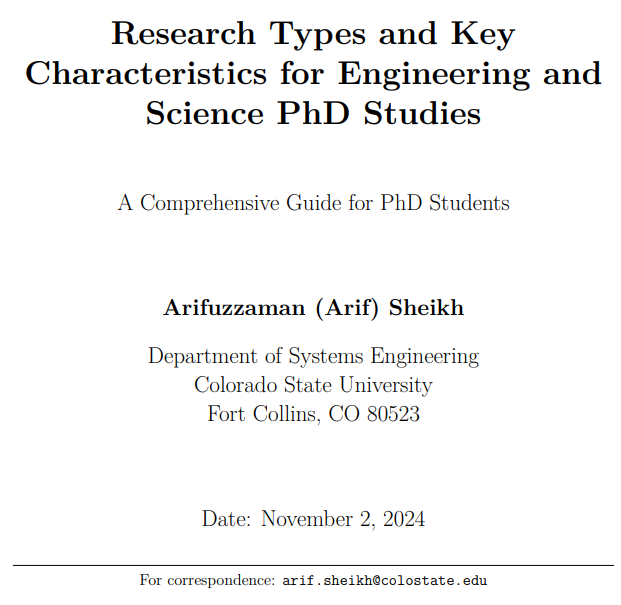
Research Guide: Engineering & Science
This white paper provides a thorough guide for graduate students, especially those in engineering and science, to understand research philosophies, methodologies, and strategies. It delivers decision-making frameworks and actionable insights to support rigorous scholarly work. By following this guide, readers will build a strong foundation in research methods and elevate their contributions to academic and professional fields.
Free Download (PDF) >>
Listen to Audio Highlights of Research Types and Key Characteristics

How to Set Up and Host Your Personal Webpage at CSU
This guide is a knowledge-sharing initiative to help fellow graduate students and faculty at Colorado State University build and host personal webpages. These steps are based on my experience and are provided as-is. For technical issues, please reach out to Engineering Technology Services (ETS).
Read More >>

Run Your Personal (Open Source) Large Language Model (LLM) Locally
This tutorial provides a comprehensive guide to optimizing AI chatbot settings for those running models on a local personal computer using open-source and free applications, making it especially useful for research and experimentation. It includes an installation guide to help you set up the necessary tools and fine-tune AI parameters for factual accuracy, creative storytelling, or technical precision, ensuring you can run models efficiently without relying on cloud-based services. Additionally, it serves as a starting point for fine-tuning models or conducting knowledge-based Retrieval-Augmented Generation (RAG) research, enabling researchers to build customized AI solutions with domain-specific knowledge.
Read More >>