Composite component distortion during manufacture is a critical problem for the industry. This area of research continues to be a prime focus area for the Composite Materials, Manufacture and Structures Laboratory researchers. The early cartoon that follows suggests the type of distortion that might occur in a composite leading edge during manufacture. In general this type of distortion has been attributed to the in-plane/out-of-plane anisotropy of laminated composites.
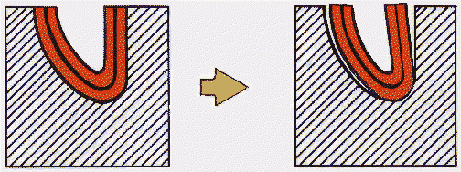
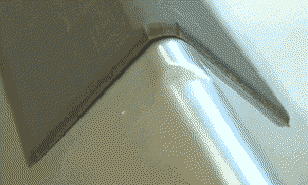
Thus, the common result of distortion during manufacture is that the composite part no longer has the exact shape of the tooling on which it was produced. To measure and predict this distortion, angle bracket specimens have been utilized. The distortion of a carbon fiber/epoxy composite angle can be seen in the following picture. This distortion is often on the order of 1-2 degrees.
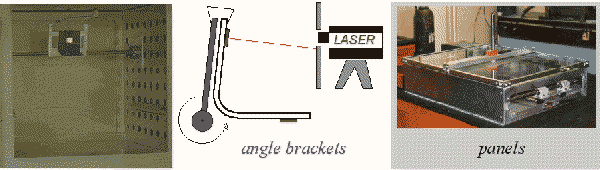
To measure the distortion of this angle bracket we could simply measure the room temperature shape; however, it has become obvious that more than one component of distortion exists. Due to the anisotropy, the angle bracket distorts in response to both temperature change (thermoelastic) and to other changes such as cure shrinkage (non-thermoelastic). Thus, we have developed testing techniques which allow both angle brackets and “flat” panels to be measured over a range of temperatures. This allows us to determine the distorted shapes and the relative change in shape with temperature. Further, this also allows us to separate the thermoelastic component of distortion from the non-thermoelastic component. In angle bracket testing, a laser is used to measure changes in specimen included angle. The specimens are in a temperature controlled chamber. For “flat” panels a probe maps the panel contour at varying temperatures.
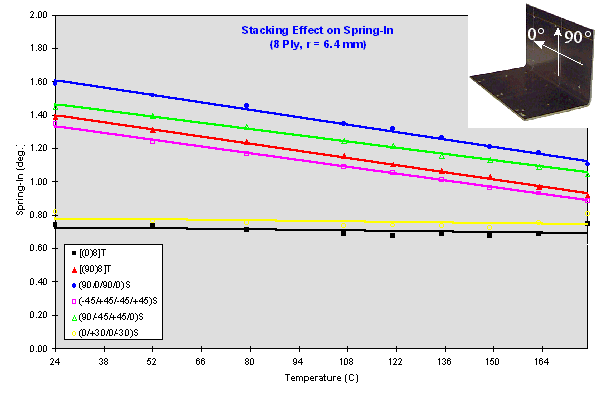
Since the degree of anisotropy in a laminate varies with many factors, tests of a number of composite variables can be accomplished. The following chart shows the effect of different stacking sequences on the thermoelastic and non-thermoelastic distortion of angle brackets. These results can also now be modeled and quite accurately predicted.
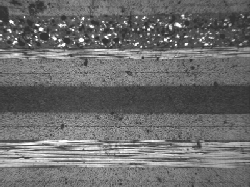
However, the composite distortion problem becomes much more complex than just anisotropy when trying to precisely predict detailed shapes. Effects of microstructure on the ultimate shape have been studied. Changes in volume fraction through the thickness of the laminate, as well as manufacturing defects can all affect the distorted shape. This portion of the effort uses computer image analysis to quantify the defects in the composite and LASER angle measurement to determine relationships between shape and temperature. Specimen shapes are measured at temperatures from room temperature to 200C to determine the thermal response. The ultimate goal is to be able to design and manufacture net-shape composite components which are shape correct and shape stable in the service environment.