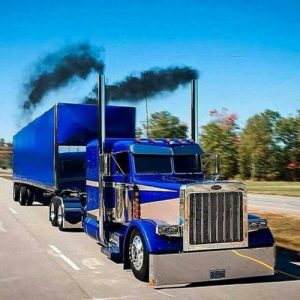
Diesel engines and vehicles account for a substantial fraction of the particulate matter (PM) and NOx emissions from the transportation sector in the US and, globally, are an important source of urban air pollution. In 2015-2016, we conducted a series of laboratory experiments at the Engines and Energy Conversion Laboratory to probe the emissions, formation, and properties of organic compounds arising from a modern-day diesel engine, with a focus on studying the impacts from the use of different engine loads (e.g., idle versus cruise), fuels (e.g., diesel versus biodiesel), and aftertreatment systems. The study was partly funded by Colorado State University and was done in collaboration with Profs. Delphine Farmer, Paul DeMott, and Sonia Kreidenweis.
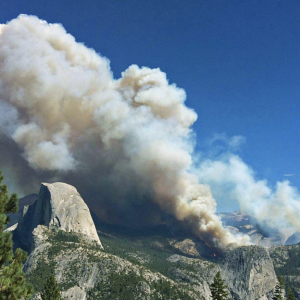
Biomass burning, which includes wildfires and biofuel combustion, is the largest combustion-related source of organic compounds to the atmosphere. These emissions can contribute substantially to regional and global air quality and radiative effects. For instance, in 2016, we participated in a large laboratory campaign – led by the National Oceanic and Atmospheric Administration (NOAA) – to study the emissions and chemistry of organic compounds in wildfire smoke. This work was funded by NOAA and the National Science Foundation.
Atmospheric aerosols undergo a large number of complex physical and chemical transformations, processes that eventually control their properties and impacts on climate and human health. We have developed several kinetic, process-level models to simulate the multiphase and multigenerational oxidation chemistry and gas-particle partitioning of organic aerosols. These kinetic models have been applied to study the precursors, processes, and properties of organic aerosol in laboratory and field environments.
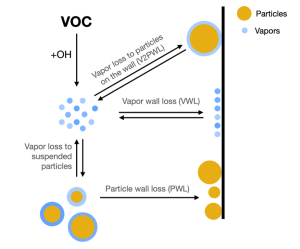
Influence of vapor and particle wall artifacts (Bilsback et al., ES&T, 2023) and aerosol phase state (He et al., 2021) on secondary organic aerosol formation in laboratory reactors.