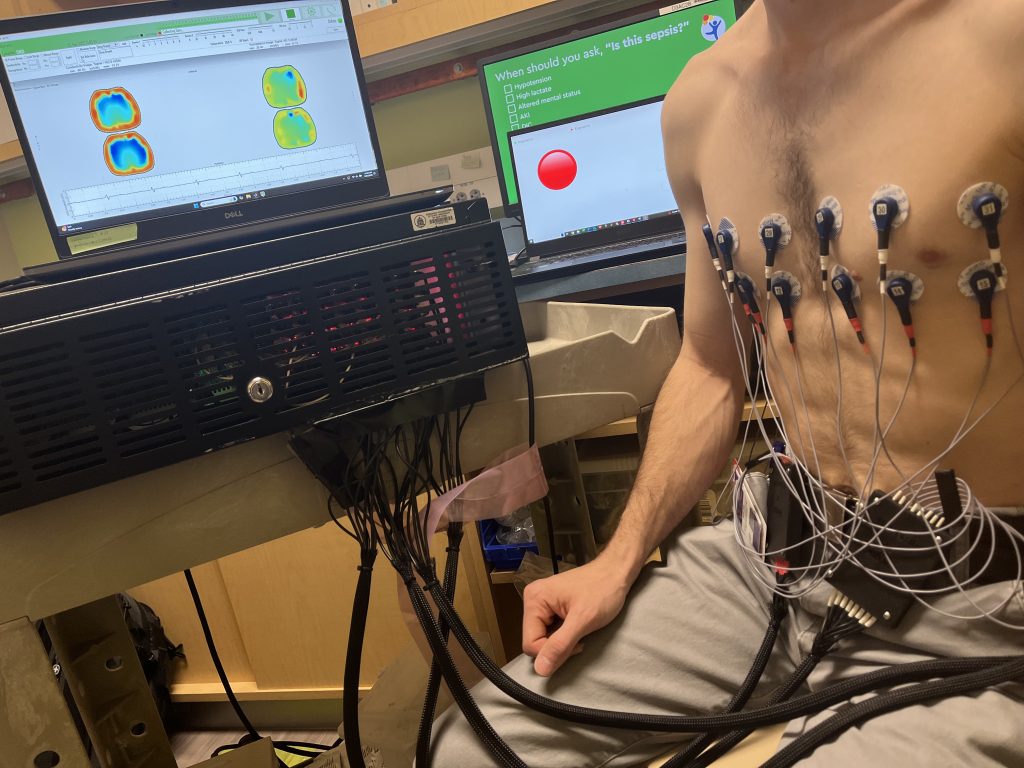
Electrical Impedance Tomography (EIT) is a functional medical imaging technique in which electromagnetic fields are used to form images of the electrical properties of the body. Founded through funding from the Department of Mathematics and College of Natural Sciences at Colorado State University and the NIH, the mission of the EIT laboratory is to develop innovative electrical impedance imaging technology for clinical applications..
Act 5
ACT 5 is a parallel-drive EIT system that applies alternating current at frequencies in the range from 5 kHz to 500 kHz and measures the resulting voltages on all electrodes simultaneously at a frame rate of fFR ≈ 27 frames/s on 32 electrodes or 54 frames/s on 16 electrodes.
ACT 5 is also the first EIT system that acquires ECG signals from all attached electrodes to the body simultaneously with EIT data acquisition. Ventilation and perfusion can be imaged in real time at the bedside without any contrast agent or averaging.
The ACT 5 hardware was developed at the University of Albany.
The system was developed under support from NIH grant 1R01EB026710.
Rajabi Shishvan, A. Abdelwahab, N. Barbosa da Rosa, G. J. Saulnier, J. L. Mueller, J. C. Newell, and D. Isaacson. ACT5 electrical impedance tomography system. IEEE Transactions on Biomedical Engineering, 2023.