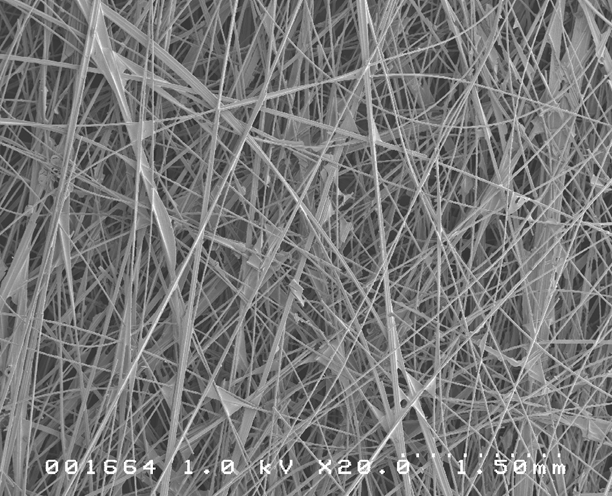
Low-density fibrous composites and structural foams are composed of three components: fiber, binder, and air. Their mechanical properties are strongly linked to constituent strength and stiffness behavior, but can also depend strongly on fiber or cell size, length, distribution, and orientation.
In this study, we are investigating the role of each of these parameters and their relationship with strength, stiffness, permeability, tortuosity as a function of fiber or cell and binder shape, size, location, distribution, strength, and stiffness. Our theoretical representation is based network models, in which each of the fibers or cell constituent is modeled as an individual element. Most studies completed in the past have focused only on the linear, small deformation behavior. Our efforts are incorporating the large displacement but small strain behavior of these elements.
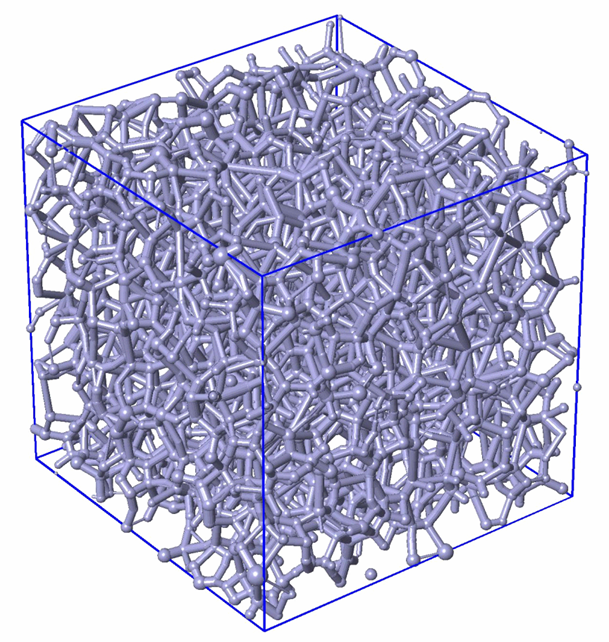
In the figures on the left, we show a typical microstructure (top) and then the mesh representation (bottom) of a low-density composite network. These representations are used to generate the complete three-dimensional stiffness tensor for the composite. We are also interested in the effective permeability and tortuosity of these fibrous networks, and are exploring network and discrete-element models of the composites to determine the nature of these quantities.
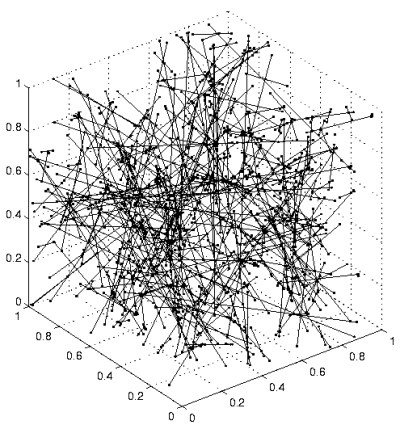
In the two figures below, a typical structural foam is shown as is its recasting as an effective assembly of one-dimensional structural components that replace the cellular structure with a network representation. We have computed the effective stiffness properties of these foams, and are currently comparing these against experiment.
This work is currently being funded by the Colorado Advanced Materials Institute and Johns-Manville Corporation, and is being accomplished in close collaboration with Dr. Karsten Thompson of LSU. Current researchers include Dr. Fernando Ramirez, Mr. C. J. Riley, Mr. Arcot Srinivasan, and Professor Paul Heyliger (CSU).
The images above are a representation of a three-dimensional low-density composite with a random fiber orientation distribution. The actual microstructure is on the top. In the lower figure, the small dark circles represent either nodal locations of binder or the intersection of the fiber and the control volume. This network gives the equivalent continuum constitutive behavior as shown below, with the stress-strain behavior shown for the six stress components. As one might expect, there is a clear distinction between the on-axis stress and those transverse to the applied stress.
The image below and right represents a three-dimensional structural foam. Using a sequential process of digitization, we replace an effective continuum with a representation of one-dimensional elements that have the effective lumped area as do the closed walls of the foam. We can then use this simplified representation to again compute the effective bulk mechanical properties of this unusual solid. The foam images are courtesy of Dr. Karsten Thompson of LSU. Below left: When every day feels like November 28: Knotted Cord, Torn Curtain, Devil's Head; clearing out deadfall on Like the Sidonians (12b), Wind Tunnel, DH; We are - ostensibly - grown men: clearing out centuries of dirt for the micro-cams on If You Want To Live (12a), The Terminator, The Park (photo by JD); "I'd rather be a garbage man in Colorado than a faculty member in (insert name of state)": near the Colorado-Wyoming border on a random day in winter; another day at the office thanks to the generosity of the Staunton family: a view from the entrance to Staunton State Park; thank you, Mr. Scott, for your support of engineering at CSU - rest in peace; sculpted by water or the hand of God - I've heard it both ways: Colorado Plateau, Utah; the incredible east face of Brookside at DH: Call the Sea to Still (12b/c); going Sistine Chapel with Spearhead, Glacier Gorge, The Park; Dr. Bennett Austin belayed a four-hour cleaning session that left him covered head to toe in moss, lichen, and dirt - never one complaint: Nine Days to the Nearest Fort (12a), Redfeather; shaded in the morning, beautiful all day long: Of Course I Still Love You (12a/b), Falcon, DH; I love you too, Groot: San Rafael Swell, Utah. Climbing photos by the incomparable Greg Hand.