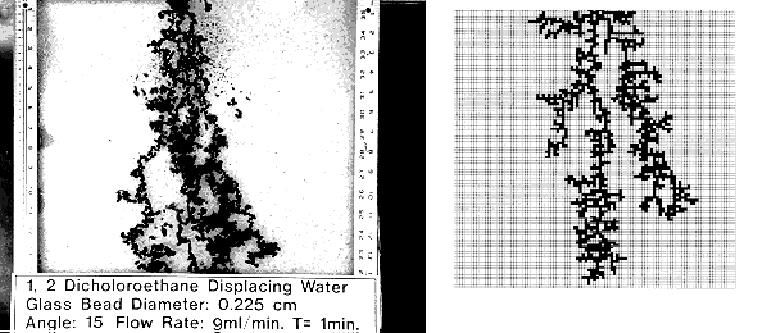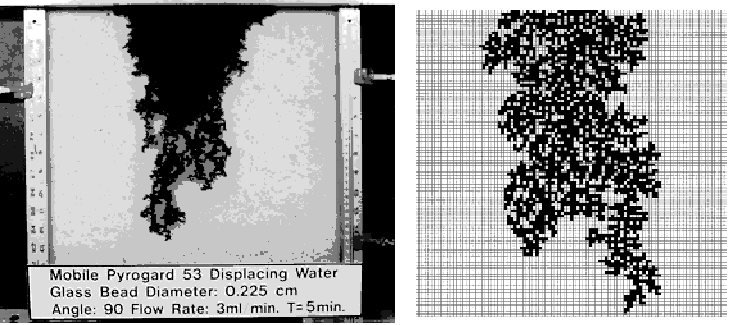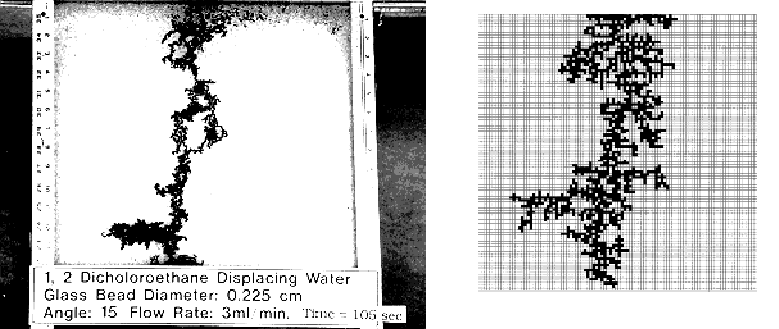
SUMMARY In response to the inadequacy of current modeling approaches and the need for accurate source zone characterization of DNAPL-water systems, a new modeling approach is currently being researched. The stochastic aggregation model is based on Witten and Sander's (1983) Diffusion Limited Aggregation technique (DLA), and predicts possible configurations of the front produced when a DNAPL displaces water at the pore-scale in a homogeneous, two-dimensional porous medium. The model inputs are the essential properties governing front stability: DNAPL-water viscosity differences, DNAPL-water density differences, intrinsic permeability of the porous media, flow rate, and the inclination angle of the porous media from the horizontal. DLA has been used to model such unstable processes as dielectric breakdown (Niemeyer, et al. 1984; Wiesmann and Zeller, 1986), diffusion-controlled polymerization (Kaufman et al., 1986), chemical dissolution processes (Daccord, 1986), solute leaching (Flury and Fluhler, 1995), viscous fingering (Maloy, et al., 1985; Chen and Wilkinson, 1985), fluid-fluid displacement in Hele Shaw cells (Kadanoff, 1985; Liang, 1986); and fluid-fluid flow in porous media (Paterson, 1984; Lenormand, 1987; Kiriakidis, et al., 1991; Fernandez, et al., 1991). The input to the model is similar to the instability criteria of Saffman and Taylor (1958) and Chouke, et al. (1959).
The following images offer comparisons of laboratory fluid displacement experiments and STAG results: