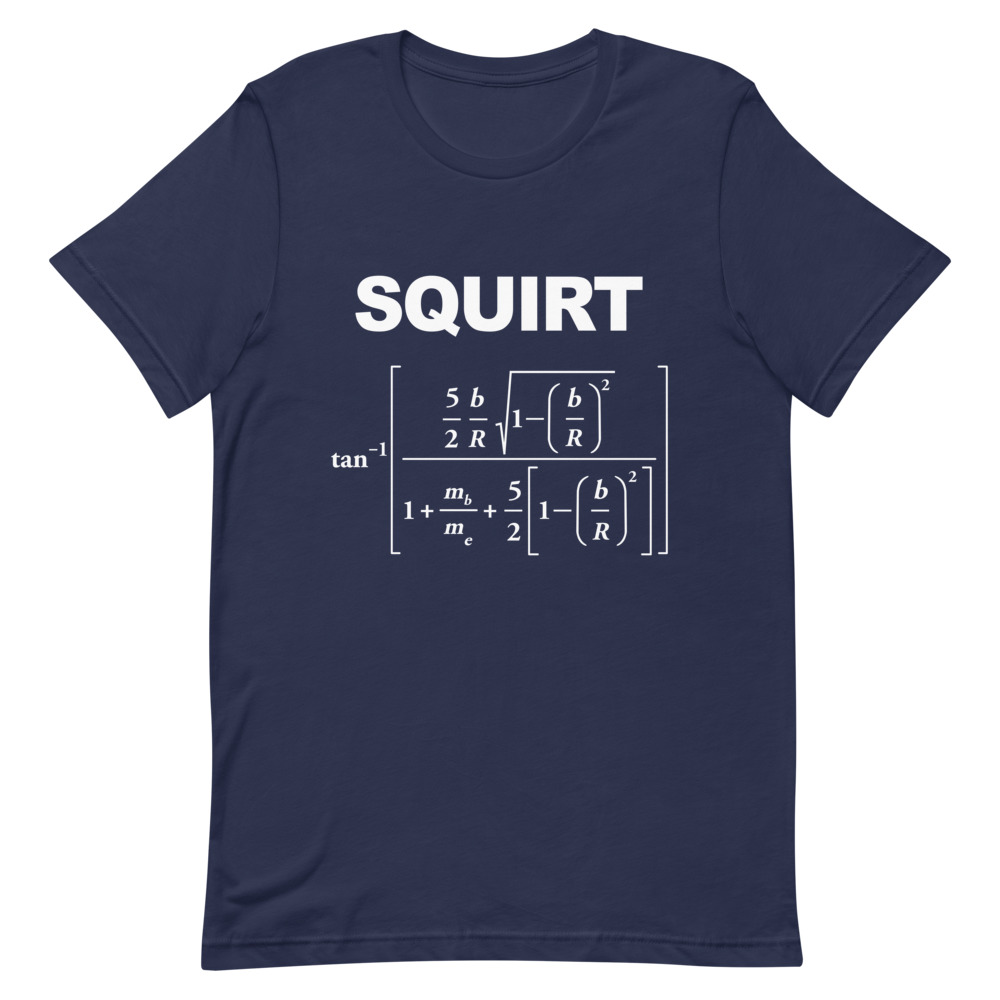
squirt

 Dr. Dave's answers to frequently-asked questions (FAQs),
mostly from the BD CCB and AZB discussion forums

maintained for the book: The Illustrated Principles of Pool and Billiards,
the DVD series: The Video Encyclopedia of Pool Shots,
and the monthly Billiards Digest "Illustrated Principles" instructional articles


for more information, see Section 4.04 in The Illustrated Principles of Pool and Billiards
and Disc II of the Video Encyclopedia of Pool Shots


aim compensation

How can I easily adjust my aim to account for squirt?

My November '07 and May '07 articles cover aim-and-pivot techniques, which can be used to adjust your aim for squirt.


endmass and stiffness

How does shaft endmass affect squirt and how is endmass related to stiffness?

See Diagram 4 in my February '08 article. People who think extra stiffness is required to produce more squirt are incorrect. Added endmass alone (without added stiffness) produces significant increases in squirt. This supports the theory in TP A.31.

However, "endmass" is related to stiffness. A stiffer shaft will typically be thicker and heavier at the end. Also, transverse shock waves will travel faster in a stiffer shaft, effectively increasing the "endmass." See the paragraph after Equation 4 in TP A.31.

For more information, see NV B.32 - Squirt and the effects of endmass, NV B.1 - Mike Page's squirt and swerve video, and my August '08 article. Also, to see how the amount of squirt can affect the miscue limit, see: HSV B.47 - effect of shaft endmass and squirt on miscue limit.


miscue limit

Does the miscue limit depend on the shaft's squirt?

See: HSV B.47 - effect of shaft endmass and squirt on miscue limit. It appears that a cue with more endmass (a lot more in the video) allows greater tip offset. With more tip offset, you would expect to get more Enlgish. You would also expect to get more squirt than you would get even with the same endmass. If you watch all of the shots in the video, you will see that the cue with the added endmass had much more squirt than the cue without the added endmass, much more than can be explained by a small difference in tip offset. Also, with more squirt comes less English (for a given tip offset), because the effective offset is less. If you look at the stripe on the ball in the super-slow-motion clips, you will see that the CB actually has slightly more English (spin per distance) with the low-squirt cue (due to a larger "effective tip offset"), even though the "actual tip offset" is slightly greater with the added-endmass cue!


published data

Where can I find published data on squirt values for various cues?

Platinum Billiards's results is the only collection of extensive data I have seen. Meucci has also done some testing measuring the combined effects of squirt, swerve, and throw, so no reliable squirt data is available. Ron Shepard's squirt paper reports a squirt angle range of about .5 to 2.3 degrees for low- to high-squirt cues, corresponding to a pivot point range of about 50" to 10". Platinum's data ranges over 1.3 to 2.3 degrees of squirt angle and 7.6" to 14.1" for pivot points. I agree Platinum's low-squirt values seem a little high, and the pivot point numbers seem way off; but, again, if their experiments were done as reported, the data is at least useful for a relative comparison.

I have some data available here. My numbers seems to fall in between the ranges reported by Shepard and Platinum.


speed effects

Does squirt change with speed?

"Cue ball deflection" or "squirt" refers to the angular deflection of the CB immediately off the tip. This is the same for both soft and hard hits. However, the CB starts sliding immediately for a shot with English; and therefore, the CB "curves" or "swerves" until sliding stops and rolling begins. For a slow shot, the swerve happens quickly over a short distance, and this reduces the "effective deflection" or "effective squirt" or "squerve" for the shot. With a faster shot, the swerve is delayed and the effective squirt is larger. I have a good demo of this here:

NV A.17 - Effective squirt vs. speed

My squirt robot experiments, which measured squirt directly, without swerve corruption, clearly show that squirt does not depend on speed like many people think. The results can be viewed here:

http://billiards.colostate.edu/bd_articles/2008/feb08.pdf

The results are also consistent with tests with a human. See those results here:

http://billiards.colostate.edu/bd_articles/2007/sept07.pdf


squirt, swerve, and throw confusion

What is squirt?

From my online glossary:

squirt (same as "cue ball deflection"): angular displacement of the cue ball path away from the cue stroking direction caused by the use of English. Squirt increases with the amount of English.

effective squirt: (same as "squerve"): the net effect of squirt and swerve (i.e., the cue ball deflection off the aiming line at object ball impact).

swerve: curve of the cue ball’s path due to cue elevation and English.

Here are some video demonstrations and explanations of squirt, swerve, and throw:

A complete summary of all squirt, swerve, and throw effects can be found here.

from Bob_Jewett:

When you use side spin, the cue ball squirts off to the side away from the tip, a little. Many players don't even notice this -- it's just a subconscious part of their game. The amount of squirt depends on your cue stick, mostly. The main thing to remember is that if you change cue sticks, you should avoid side spin on important shots until you get used to the stick.


How can you predict the directions and amounts of squirt, swerve, and throw with various types of shots?

I’ve gotten several e-mail questions concerning Diagram 3 in my August '07 article. Here's the diagram:

Several people have suggested the throw direction is wrong due to collision- or cut-induced throw (CIT). Before giving you my answer, think about it yourself and decide if you think the diagram is correct or not. Also, many people seem to be confused by the real effects of squirt and swerve. I think Diagram 4 from the article (see below) helps clarify things.

I use the phrase "effective squirt" for the net effect of squirt and swerve. Some people like to call this "squerve." My series of articles on squirt covers all of the details of squir and swerve.

Now back to Diagram 3. Throw direction depends on the direction of the relative motion of the surface of the cue ball in contact with the object ball. This direction is affected by both cut angle and spin. I think my January '07 and February '07 articles illustrate the different possibilities quite well. Please refer to them. I think the throw direction shown in Diagram 3 of my August article is appropriate given the amount of English.

Object ball throw depends on cut angle, shot speed, type and amount of English, and the amount of vertical plane spin (draw, follow, stun). My series of twelve articles on throw elaborate on all of these factors. Collision-induced throw (CIT) and spin-induced throw (SIT) are just different names for throw, depending upon the primary cause of the throw, but the effects don't really combine as separate factors.


straight-in shot with unintentional English

What effects do squirt, swerve, and throw have with a straight-in shot hit with unintentional English?

I think there are two possible cases here:

1.) The cue is aligned in the proper aiming line direction but shifted to the left a little, creating unintentionally left English, but the stroke is straight. In this case, the CB will squirt to the right (the amount depends on the cue and the amount of tip offset), the CB will swerve back some to the left (the amount depends on shot speed, cue elevation and ball/cloth conditions), the contact point might be to the left or right of the initial target depending on the relative amounts of squirt and swerve, then the English will throw the OB a little to the right of what the contact point suggests.

1.) The cue is aligned in the proper aiming line direction and the cue tip is aligned with the center of the CB, but the stroke is not perfectly straight, resulting in slight unintentional left English. In this case, the aiming line is now pivoted to the left a little, so the CB will tend to head to the left a little (the amount will depend on bridge distance). Everything else is the same as with "1," but now relative to this new aiming line direction.


tip hardness effects

Does the tip hardness affect the amount of squirt (CB deflection) a cue creates?

See my August '08 article. Tip hardness has only a slight effect on a cue's squirt ("cue ball deflection"). In the article, I show plots of real data taken with a cue-testing robot.